Pick-Up Stick Weaving: Unlocking Pattern on a Simple Loom
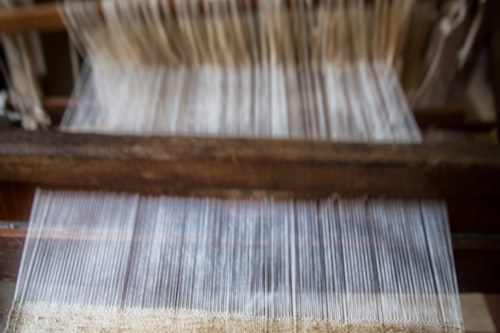
The pick-up stick is a flat, smooth tool — usually wood, sometimes plastic or bamboo — pointed at both ends and roughly the width of the loom. It goes into the warp. The weaver uses it to manually lift selected individual warp threads over or under the stick, building a specific sequence. When the stick is turned on its side, it props open a shed that would otherwise require additional shaft or heddle equipment to create. That shed is the "pick-up" shed, and it gives the technique its name.
It sounds painstaking and it is — at least for the first row or two. Once the pick-up sequence is established, the stick can often stay in the warp and be used repeatedly, row after row, alongside the standard heddle-controlled sheds. The result is a fabric with pattern — floats, lace openings, supplementary weft inlays, mock-twill diagonals — on equipment that theoretically only makes plain weave.
Why It Matters for Rigid Heddle Weavers
A rigid heddle loom has one heddle position: up or down. The heddle controls two sheds — the warp threads that sit in the slots rise when the heddle rises; the threads sitting in the holes rise when the heddle descends. That gives you two alternating sheds, which is exactly what plain weave requires. Nothing more.
Pick-up stick technique breaks out of that constraint. By manually selecting specific threads from the slot threads (which are not controlled by the heddle holes), the weaver creates a third shed — the pick-up shed — that produces a different interlacement pattern. Threading the warp with two heddles instead of one expands this further. Experienced rigid heddle weavers can produce twill weave approximations, honeycomb structures, lace patterns, and quite complex supplementary weft brocade using pick-up sticks and multiple heddles, without ever moving to a shaft loom.
Modernhaus follows the thread from raw fiber to finished fabric.
Explore the Textile Studio →The Tool
The stick itself requires almost nothing. A piece of smooth hardwood, perhaps 16 inches long and an inch wide, with sanded ends. Some weavers use purchased tools; others use wooden rulers or repurposed kitchen implements. The requirements are smoothness (so it slides between warp threads without snagging), flatness (so it can be turned on edge to prop open a shed), and a length equal to or slightly greater than the weaving width.
Multiple sticks can be inserted into a warp simultaneously, holding several different pick-up sequences. The limit is the depth of the warp from front beam to back beam — too many sticks and there is no room to work.
The Same Idea in Other Traditions
Pick-up technique is not invented by modern rigid heddle weavers — it is ancient and widespread. Backstrap loom weavers across Mesoamerica and the Andes use shed sticks and pattern sticks that operate on the same principle: manually selecting threads to create supplementary sheds that produce pattern. The shed sticks in a backstrap loom are the predecessors of the rigid heddle weaver's pick-up stick.
Inkle loom weavers use similar manual selection to create pattern pick-ups in narrow warp-faced bands. Tablet weaving achieves the same structural goal — controlled floats and pattern sequences — through a completely different mechanism, but the underlying goal is identical: more pattern control than the basic shed mechanism allows.
What Pick-Up Cannot Do
There is a ceiling. The more complex the pick-up sequence, the slower the weaving. A floor loom with four or eight shafts mechanizes the shed selection that pick-up technique does by hand, and it does it reliably and quickly. Weaving twill weave on a four-shaft loom at a reasonable pace takes considerably less time than weaving a pick-up approximation of the same structure on a rigid heddle.
Most weavers who develop pick-up skills do so either because they don't have a shaft loom, or because they are interested in the control and spontaneity that manual thread selection provides — the ability to change the pattern sequence mid-weave, adjust a design while looking at it, or work from an improvised rather than pre-calculated sequence. The constraint of the simple loom becomes, in skilled hands, a different kind of flexibility.