Eero Aarnio: The Ball Chair Is a Room Inside a Chair
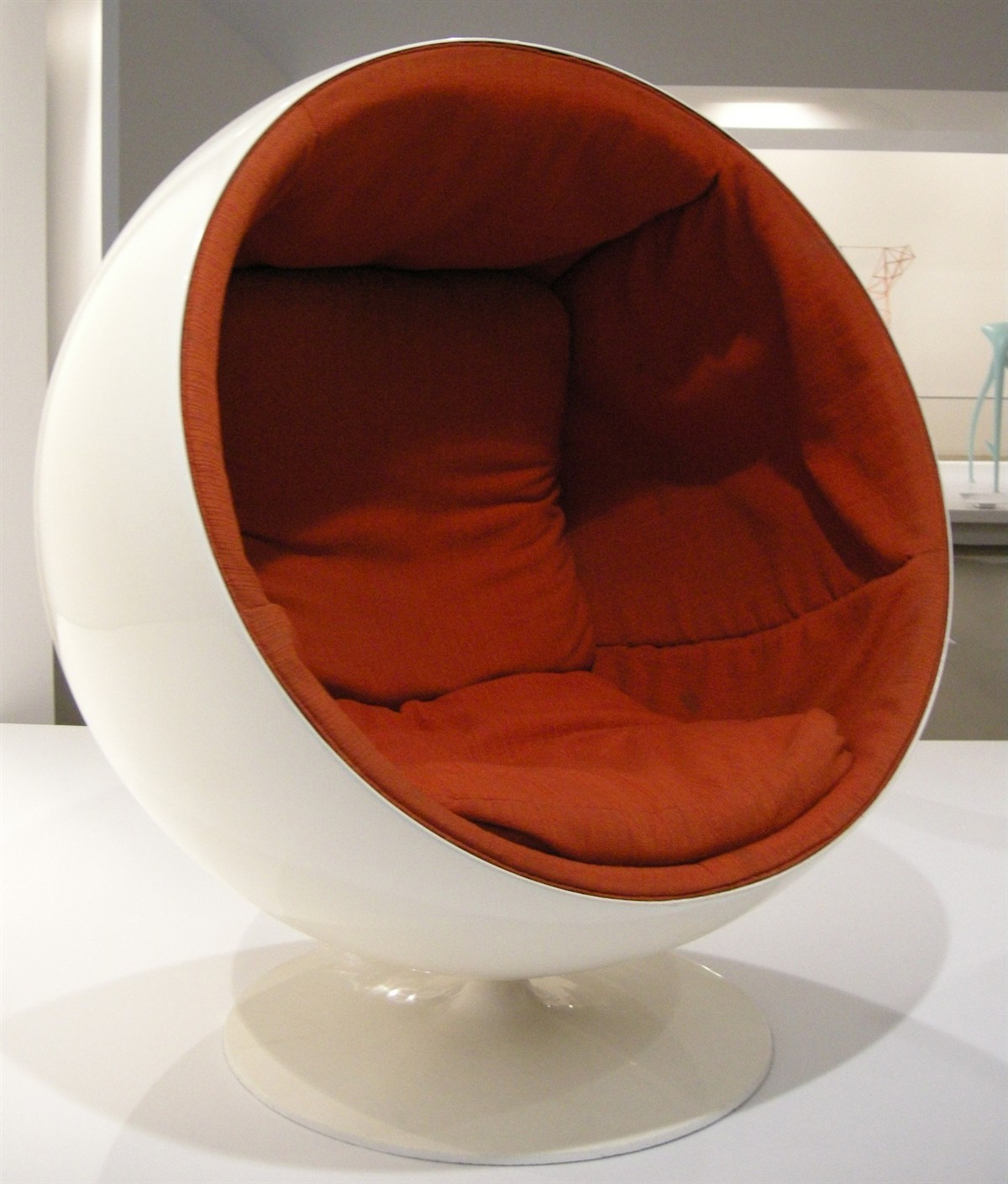
Eero Aarnio was born in Helsinki in 1932 and studied at the Helsinki Institute of Design. He established his own design studio in 1962. The following year he designed the Ball Chair, and from that point his place in design history was secured whether or not he went on to do anything else. He went on to do quite a lot else.
The Ball Chair is a sphere of fibreglass — about 120 centimetres in diameter — with a quarter of the front face removed to create an opening. Inside, the sphere is upholstered. A phone was sometimes built into the interior. The whole thing sits on a single pedestal base that allows the chair to rotate. You climb in and swivel to face whatever direction you want, and the curved walls around you muffle the room outside and create a small, contained world.
It sounds eccentric. It is eccentric. It is also genuinely comfortable and psychologically interesting in a way that most chairs aren't — because it addresses something real about why people sometimes want to be enclosed rather than exposed, held rather than simply supported.
Fibreglass and the Space Age
The Ball Chair was possible in 1963 because fibreglass was becoming a practical manufacturing material for furniture. It could be formed into compound curves that would be extremely difficult or expensive in wood or steel, it was relatively light, and it could be finished in any color. Aarnio loved these properties and used them as extensively as anyone working in the 1960s.
The Pastil Chair from 1967 takes this further: a disc-shaped fibreglass form with a curved seat, low enough that sitting in it puts you close to the floor, shaped like a large candy or a flattened sphere. It won the American Industrial Design Award in 1968. It can also float on water, which wasn't the original intention but became one of those product facts that tells you something interesting about where the 1960s thought leisure was going.
The Bubble Chair from 1968 pushed the material in a completely different direction: instead of opaque fibreglass, transparent acrylic, hung from the ceiling on a steel cable. The enclosure is there — the sphere, the sense of containment — but now it's transparent, so you're simultaneously inside your own space and visible to the room. It was designed to hang in front of a large window, with daylight all around.
These are not variations on a theme so much as a sustained investigation of a question: what does it mean to design furniture that isn't just a platform for the body but a small environment for the person?
Modernhaus documents mid-century modern design history in one place.
Explore the Design Archive →Finnish and Not
Aarnio is Finnish, and the Finnish design tradition in the mid-century period included work by Eero Saarinen — who was also Finnish-born, though he spent his career in America — and Alvar Aalto and a number of others working in a tradition that balanced modernist principles with an attachment to organic form and an interest in natural and industrial materials simultaneously.
But Aarnio's work sits slightly outside that tradition. The Ball Chair and the Bubble Chair and the Pastil Chair are not Nordic-restrained; they are space-age exuberant. They belong more to the international mood of the 1960s — the same mood that gave us Verner Panton's inflatable interiors and Joe Colombo's total living systems — than to the quiet functionalism of the Finnish design mainstream.
That's not a criticism. It's just that Aarnio was asking a different question. Where Aalto was asking how to make industrial materials feel human and warm, Aarnio was asking what furniture would look like if the future people were imagining in 1963 actually arrived.
Still in Production
All three of the main Aarnio chairs — Ball, Bubble, Pastil — are still in production through Adelta, a Finnish manufacturer. This is unusual: many iconic designs from the 1960s went out of production and came back through reissue programs, but Aarnio's chairs have remained continuously available in some form.
The Ball Chair in particular has become one of those objects that appears in photographs as shorthand for a certain kind of forward-looking design attitude — in tech offices, in film sets meant to look futuristic, in interiors that want to make a point about not being ordinary. It has been used so often as a visual cliché that it's easy to forget it was a genuine formal invention that nobody had done before 1963 and that solves a real problem, with considerable elegance, in fibreglass.
Aarnio still works in Helsinki. He has designed toys, garden furniture, exhibition installations, and a wide range of chairs beyond the famous three. In interviews he tends to credit the Ball Chair to a specific and simple observation: that people, given the chance, like to curl up inside things. It's the same reason children make forts. The chair just takes that seriously.