Eero Saarinen: The Architect Who Dissolved Furniture
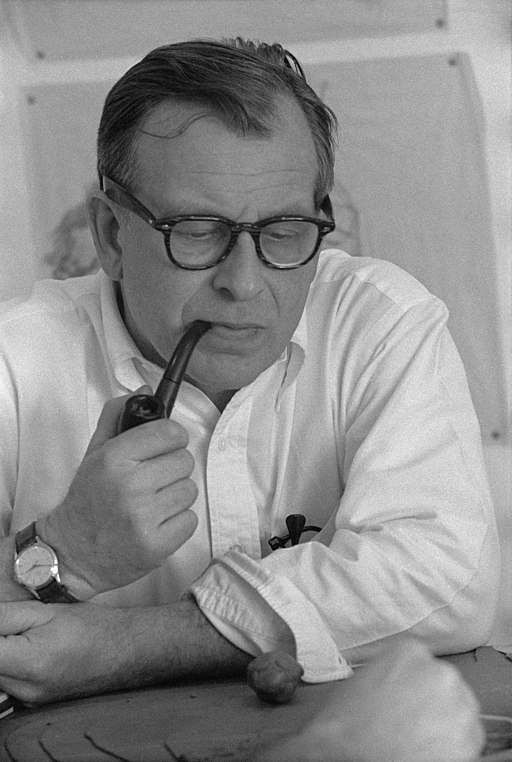
In August 1961, Eero Saarinen checked himself into a hospital in Ann Arbor with headaches. He was in the middle of moving his architecture firm from Detroit to New Haven: twelve projects active, the TWA Flight Center at JFK nine months from opening. He probably expected the doctors to give him something and send him home.
They found a brain tumor instead.
His surgeons gave him a very slim chance of survival. He took it. He died on September 1, 1961, age 51. The TWA terminal opened on May 28, 1962, and the Christian Science Monitor called it "perhaps the finest example of the creative genius of the late Eero Saarinen." He never saw a single passenger walk through the building he'd spent years designing to look like a bird in mid-flight.
There's something about that particular image that stays with you: not just the tragedy of it, but the shape of it. A man who spent his whole career designing spaces for human movement, never getting to stand inside his most famous one and watch people actually move through it. His partners had to reverse-engineer his intentions from sketches and scale models to finish the building. They knew it well enough by then to do it. But still.
What Saarinen managed to think up and build before he died at 51 is the real story. A Finnish kid who grew up on a construction site that became America's most influential design school, who spent five years and $70,000 of his client's money trying to solve one very specific problem (too many table legs), and who ended up defining what a certain kind of mid-century dining room looks like to this day.
The Construction Site That Became a School
Eero was born in Finland in 1910, but the story that matters really starts in 1922, when his father Eliel Saarinen entered the Chicago Tribune Tower competition. The brief: design a building for Chicago's most powerful newspaper. The winner would be announced to the world's press.
Eliel came second. First prize went to a neo-Gothic tower by Howells and Hood that is handsome, competent, and essentially forgotten. The second-place design was something different: a setback skyscraper that anticipated what American architecture was about to become by roughly a decade. Louis Sullivan, arguably the father of modern American architecture, called Eliel's design "the most beautiful building in the world." The prize money was $50,000, and it went to someone else. The losing design influenced more than the winner did.
The family emigrated to America in 1923. Eliel was soon invited to Michigan by a newspaper publisher named George Booth, who had an unusually expansive idea of what an art school could be. He wanted to build one in Bloomfield Hills. He wanted Eliel to design it and then run it.
The result was the Cranbrook Academy of Art, and for young Eero it was a childhood unlike almost any other. He grew up on the construction site of what would become America's most influential design school: a campus being built around him, in a house his father had designed, surrounded by people for whom architecture and craft and art were simply the texture of daily life. Charles and Ray Eames met at Cranbrook. Harry Bertoia taught there. And among the students who passed through in those years was a girl named Florence Schust, who became such a presence in the Saarinen household that she was, to all practical purposes, an extended member of the family. She and Eero developed something like a sibling relationship, built over years of shared dinners and design arguments.
Twenty years later, she would become his most important client.
Modernhaus documents mid-century modern design history in one place.
Explore the Design Archive →Florence Knoll and the Chair Shaped Like a Womb
Florence Schust married Hans Knoll in 1946 and became Florence Knoll, the driving force behind Knoll Associates' postwar design program. She was not a passive client. She had strong ideas, proper architectural training, and the history of having grown up arguing about design at the Saarinen family table. When she commissioned work from designers, she was commissioning from people she understood deeply.
When she came to Eero, sometime in the mid-1940s, the brief was personal. She wanted, as she put it, "a basket full of pillows." A chair you could properly curl up in, something that worked for both the formal entertaining of a postwar professional household and the entirely practical need to sit in one position for more than twenty minutes without discomfort. She was not really describing a piece of furniture so much as a feeling.
Saarinen's solution, which took two years to develop, was built on a theory that sounds slightly absurd until you sit in one: that "a great number of people have never really felt comfortable and secure since they left the womb." The chair is shaped to hold the whole body, not just the parts of it that technically do the sitting. The back curves around. The sides come in. You don't so much sit in the Womb Chair as get held by it.
It launched in 1948 at $270, around $3,400 in today's money. Knoll manufactured 1,200 in the first year; by the mid-1950s they were producing 500 a month. What Florence asked for as a personal favor from someone she'd known since childhood became one of the best-selling chairs in the history of American furniture. This is not an unusual pattern for Saarinen: the most personal and human of briefs consistently produced his most lasting work.
The Slum of Legs
By 1953, something specific was bothering Saarinen. He photographed interiors obsessively for reference, and whenever he photographed a room, the floor level was a visual mess: chair legs, table legs, stretcher bars, casters, the entire undercarriage of modern furniture creating what he called, with characteristic directness, "an ugly, confusing, unrestful world." He called it "the slum of legs."
"We have chairs with four legs, with three and even with two," he told Florence Knoll around 1953, "but no one has made one with just one leg, so that's what we'll do."
This sounds like it should precede a simple project. It did not. Saarinen spent five years on it, and Knoll spent $70,000, roughly $780,000 in today's money, developing what became the Pedestal Collection. The structural problem is genuinely unforgiving: a single-stem chair needs to put all its load through one point, and making that safe without making the chair look like a traffic bollard took fifty different base designs and multiple collapsed prototypes before anything workable emerged.
The solution used a rilsan-coated aluminum base, hollow but internally ribbed for strength, with the weight distributed to create a cantilever effect. It worked. It also looked like it shouldn't, which was partly the whole point.
Here's the thing Saarinen never quite got over: he wanted the base and seat to be one continuous material, like a flower growing from the ground. Technology couldn't give him that. The fiberglass seat required an aluminum base, painted to match as closely as possible. He called this a compromise until he died. The Tulip Chair was, by his own assessment, a failure.
It is also the most copied chair in the history of modern furniture. Knoll holds design trademarks and has sued dozens of companies over the decades; the core patents expired in the 1970s and there was nothing further to be done. Industry estimates put Tulip-style chair sales at roughly half a million units a year across the world. IKEA's version, the DOCKSTA, has shifted several million units at $179 each. The original from Knoll costs $2,692 for a single dining chair.
The most expensive failure in mid-century design, and arguably also its most enduring success.
The Building That Looks Like It's Already Leaving
When TWA commissioned Saarinen to design their terminal at Idlewild Airport in 1956, they got a building that is, by any reasonable measure, too much. Every surface is curved. There are no right angles in the passenger areas, none at all. Two concrete shells meet at a central spine and the whole form crouches above the ground like something paused briefly before taking off again. Critics have written that his designs "went beyond the measly ABC of modernism." The TWA terminal is the clearest evidence for that claim.
The interior matches the exterior completely. Information boards are curved. Check-in desks are curved. The staircase rails follow the same lines as the roof. Walking through it is not quite like being inside a building; it is more like being inside an argument about what a building should feel like when what it's for is the specific emotional experience of going somewhere. The concrete formwork alone cost $3 million. Each curve required custom wooden molds. Workers hand-shaped every surface. The construction company reportedly lost money on the project despite the enormous budget.
He never saw it. The terminal opened on May 28, 1962. Saarinen had been dead for nine months.
After 51
His partners Kevin Roche and John Dinkeloo spent two years completing his projects from models and sketches. They finished TWA. They finished the Gateway Arch in St. Louis, which opened in 1965 as a weighted catenary curve, the same mathematical form Saarinen had applied to furniture legs. They finished the CBS Building in New York, which opened the same year.
Knoll closed the furniture catalog at fifteen pieces, with reportedly over two hundred unreleased sketches and prototypes held in their archives. That catalog of fifteen items generates around $280 million annually for Herman Miller, which acquired Knoll in 2021. The Tulip Table appears in roughly one in three hundred Instagram photos tagged with "dining room." The Womb Chair replica market starts at around $800; the authentic Knoll version runs to around $7,500 for the chair and ottoman together. A 1957 Womb Chair sold at Wright Auction in 2023 for $8,750, against an original retail of $270.
The TWA terminal, having sat empty for eighteen years after closing in 2001, reopened in 2019 as the TWA Hotel. The renovation cost $265 million. Saarinen's original conversation pit now serves $28 martinis. Room rates start at $300 a night.
There is something genuinely strange about all of this. The most visited part of Saarinen's legacy is a building he never walked through. But then, he spent his whole career designing for arrival: for what it should feel like to step into a space that was waiting for you. He just never got to be the one arriving.
He took a very slim chance on surgery because twelve projects were active and the building wasn't finished yet. He lost the bet. The building opened without him, and it's been full of people ever since.