Earthenware vs Stoneware: What Clay Temperature Actually Changes
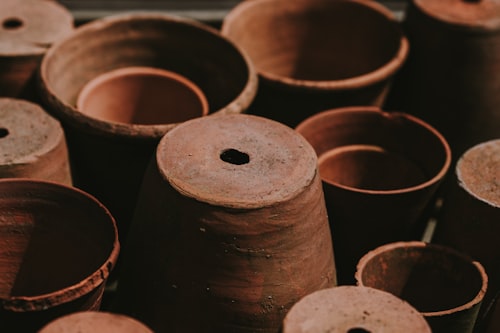
The distinction between earthenware and stoneware is a temperature distinction. Both are made from clay. Both are fired in a kiln. What separates them is how hot that kiln gets, and what the heat does to the clay body at different temperatures.
Earthenware fires in the range of roughly 1,800°F to 2,100°F (cone 06 to cone 2 in the system used by most studio potters). At these temperatures, the clay hardens but does not fully vitrify — the particles fuse at their edges but significant porosity remains in the body. An unglazed earthenware pot left in water will slowly absorb it. You can feel the difference when you tap the two materials: earthenware produces a dull thud; stoneware rings.
Stoneware fires above about 2,200°F (cone 6 and above). At these temperatures, the silica and flux materials in the clay body begin to melt into a glassy matrix that fills the spaces between particles. The clay vitrifies — it becomes stonelike, dense, watertight without glaze. You could, in principle, drink from an unglazed stoneware cup. You could not do the same from earthenware without risking bacterial growth in the pores.
Terracotta Is Earthenware
Terracotta is earthenware. The Roman amphora, the Greek krater, the Mexican cazuela, the Mediterranean roof tile — all earthenware, all porous, all relying on that porosity in different ways. The water absorption that makes an earthenware pot technically imperfect for storing liquids is precisely what makes a terracotta pot useful in the garden: it breathes. The unglazed clay pot allows gas exchange at the root level that a stoneware or plastic pot prevents.
Pit firing produces earthenware-range results. The maximum temperature of an open pit fire rarely exceeds 1,400°F — well below earthenware firing range, let alone stoneware. The objects that emerge are hardened but fragile, decorative rather than functional in a utilitarian sense. Ancient earthenware cooking vessels compensated for porosity by being seasoned with fats, just as cast iron is seasoned today.
Modernhaus documents studio pottery from wheel to kiln.
Explore the Clay Studio →Porcelain
Porcelain is a subset of high-fire ceramics that uses kaolin clay — extremely white, extremely refractory — and fires at temperatures comparable to stoneware but produces a translucent, vitrified body with different working properties. Chinese porcelain fired at temperatures European kilns couldn't achieve until the eighteenth century. The Dresden manufacture at Meissen — the first successful European hard-paste porcelain — resulted from years of experiments trying to reverse-engineer Chinese wares from visual inspection alone.
Stoneware is more forgiving than porcelain. It tolerates a wider range of clay bodies, more variation in firing temperature, and a broader vocabulary of glazes. Most contemporary studio pottery — the bowl your coffee sits in, the plate your breakfast comes from — is stoneware.
What the Clay Contains
Earthenware clays tend to be high in iron and other fluxes that melt at lower temperatures, which is why they work at earthenware temperatures. They are also typically more plastic — easier to throw on the wheel, more forgiving of errors, stickier to work. The iron content is why earthenware tends toward red, orange, and brown when unglazed.
Stoneware clays fire gray, tan, buff, or speckled depending on their mineral content. Many studio potters work with commercially blended stoneware bodies formulated for specific properties — throwing, hand building, sculptural work — rather than digging raw clay. The blended bodies sacrifice some of the personality of natural clay for consistency.
Why It Matters to the Potter
The temperature distinction affects glaze chemistry, firing schedule, kiln type, and energy cost. Stoneware kilns require more energy to reach temperature. Electric kilns that fire to stoneware temperatures are considerably more expensive to run than earthenware kilns. Gas kilns, wood kilns, and soda kilns (like soda firing) are often used for stoneware specifically because they can create the atmospheric effects — reduction coloration, salt deposits — that are difficult to achieve in electric kilns.
Raku pottery is earthenware-range firing: the dramatic effects of Japanese raku and Western raku both occur at relatively low temperatures. Burnished pottery works at earthenware temperatures because the burnish survives firing better at lower heat. The entire category of terra sigillata and terra sigillata slips is an earthenware tradition.
The choice between earthenware and stoneware is not a quality judgment. It is a decision about what the piece needs to do and what visual character is wanted from the clay body itself.