Burnished Pottery: The Glaze That Isn't a Glaze
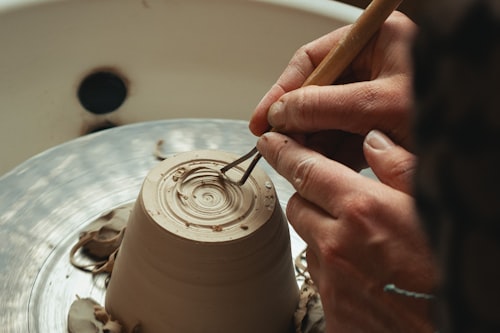
Burnishing is not coating. It is not a finish applied to the surface from outside. It is the compression of the clay surface itself — the flattening and reorienting of the clay particles until they lie parallel to the surface and begin to reflect light. The tool glides over leather-hard clay with firm, overlapping strokes. The surface transforms from matte and slightly rough to smooth and then, with enough passes, to something approaching a shine.
The tool can be almost anything smooth and hard: the back of a spoon, a river-worn stone, a piece of polished agate, a bone, a glass rod. The traditional tools in many cultures are inherited objects, smoothed further by generations of use. The Puebloan potters of the American Southwest, some of the most technically accomplished burnishers in the world, work with polishing stones that have been passed through families for centuries.
Why It Works
Wet clay is composed of flat, plate-like particles suspended in water. As the clay dries, those particles settle into random orientations. Burnishing — applying lateral pressure with a smooth tool at the leather-hard stage, when the clay is firm enough to hold its shape but still slightly plastic — forces those particles to align parallel to the surface. The aligned surface reflects light differently than the random surface. That is the shine.
Firing partially destroys the effect: the clay particles reorganize somewhat under heat. But a well-burnished surface, fired slowly and at appropriate temperature, retains significant sheen after firing. At low temperatures — under 1,800°F — the burnish survives well. At higher temperatures, the clay begins to vitrify and the burnish becomes meaningless, replaced by the melting of the clay body itself.
This is why burnishing belongs primarily to earthenware and low-fire traditions, and why it pairs naturally with pit firing and similar low-temperature techniques.
Modernhaus documents studio pottery from wheel to kiln.
Explore the Clay Studio →Maria Martinez and San Ildefonso Blackware
The most famous burnished pottery in the twentieth century came from San Ildefonso Pueblo in New Mexico, and specifically from Maria Martinez and her husband Julian. Working in the 1920s, they revived and refined a technique for producing matte-on-shiny blackware — pots with burnished backgrounds and matte painted designs — that had been made in the region centuries earlier and had fallen out of production.
The firing technique involved smothering the fire at peak temperature with powdered manure, creating a dense reducing atmosphere that turned the iron in the clay body to black magnetite. The burnished areas stayed shiny. The areas painted with a refractory clay slip stayed matte. The contrast — black mirror against black velvet — was visually striking in a way that had no equivalent in European ceramics.
Maria signed her work "Maria" — and later, after Julian's death, "Maria Poveka." The pots became collector objects, then museum objects. She is one of the few twentieth-century ceramicists whose work is immediately recognizable by name to people who know nothing else about pottery.
Terra Sigillata
Terra sigillata — the refined, deflocculated clay slip used by Roman potters — functions as an intermediate between burnishing and glazing. Applied thinly to the leather-hard surface and burnished lightly, it produces a surface denser and more reflective than burnished bare clay. The Romans used it on their red-slipped tableware; contemporary studio potters use it before pit firing to increase surface quality and color response.
The combination of terra sigillata and burnishing produces some of the most visually complex surfaces available in low-fire ceramics — depth and variation that glaze surfaces achieve differently and sometimes less interestingly.
The Practice
The timing is critical. Too wet, and the clay smears and deforms under pressure. Too dry, and the tool scratches rather than polishes, and the clay particles are too stiff to realign. The correct window — leather-hard, firm to the touch, no longer cold to the cheek — lasts a few hours for small pieces in normal conditions and can be extended by working in humid environments or wrapping partially burnished pots between sessions.
Most potters who burnish seriously work a surface multiple times over multiple days, drying slightly between sessions. The first pass compresses. The second reveals what the first missed. The third and fourth begin to produce the depth of surface that distinguishes a well-burnished pot from one that received a single quick pass.
The patience it requires is real, and it is probably why burnishing fell out of favor once glaze technology matured. Glaze covers and transforms. Burnishing reveals what is already there and makes it better. They are different relationships to the material.