Hans Wegner: The Chair That Changed an Election
On September 26, 1960, John F. Kennedy and Richard Nixon sat down for the first televised presidential debate in American history. The two candidates sat in Hans Wegner chairs. Viewers in the United States who had never heard of Danish furniture design suddenly wanted to know where those chairs came from. Interior designers fielded calls for weeks. Wegner's Round Chair — which he had simply called "the chair" when he designed it in 1949, and which the rest of the world soon started calling that too — became the most famous chair in the world almost by accident.
Wegner himself was unimpressed by the fuss. He had designed the chair eleven years earlier, working through a problem that had occupied him for years: how to make a wooden armchair that worked equally well from every angle, with no front or back, so it could be pulled from a table and turned to face any direction without the back becoming an obstacle. The solution was a continuous curved top rail and arm, a round seat, and four legs angled slightly outward. He made it in oak, in teak, in ash. He was thirty-three years old.
Trained as a Cabinetmaker
Wegner was born in 1914 in Tønder, in southern Jutland, and trained as a cabinetmaker before studying furniture design at the Copenhagen School of Arts and Crafts. The cabinetmaker's training was not incidental to his work: it meant he understood wood as a material from the inside, knew what it would do under stress and over time, and could draw joints that would actually work rather than joints that looked good on paper and failed in the workshop.
This is what distinguishes Danish furniture design of the mid-century period from a lot of what was happening elsewhere. Where American designers were working primarily through industry — Florence Knoll commissioning work from Harry Bertoia, Herman Miller developing furniture for mass production — Wegner was designing furniture that would be made by hand in workshops, to tolerances only possible with skilled labor. The Wishbone Chair, designed in 1950, has a seat woven from paper cord: a traditional craft technique given a new form, requiring skilled weavers to complete each chair.
Modernhaus documents mid-century modern design history in one place.
Explore the Design Archive →Five Hundred Chairs
Wegner designed more than five hundred chairs across a sixty-year career. That number is genuinely extraordinary. It is not the output of someone who had one idea and refined it: it is the output of someone who kept finding new problems in the same territory.
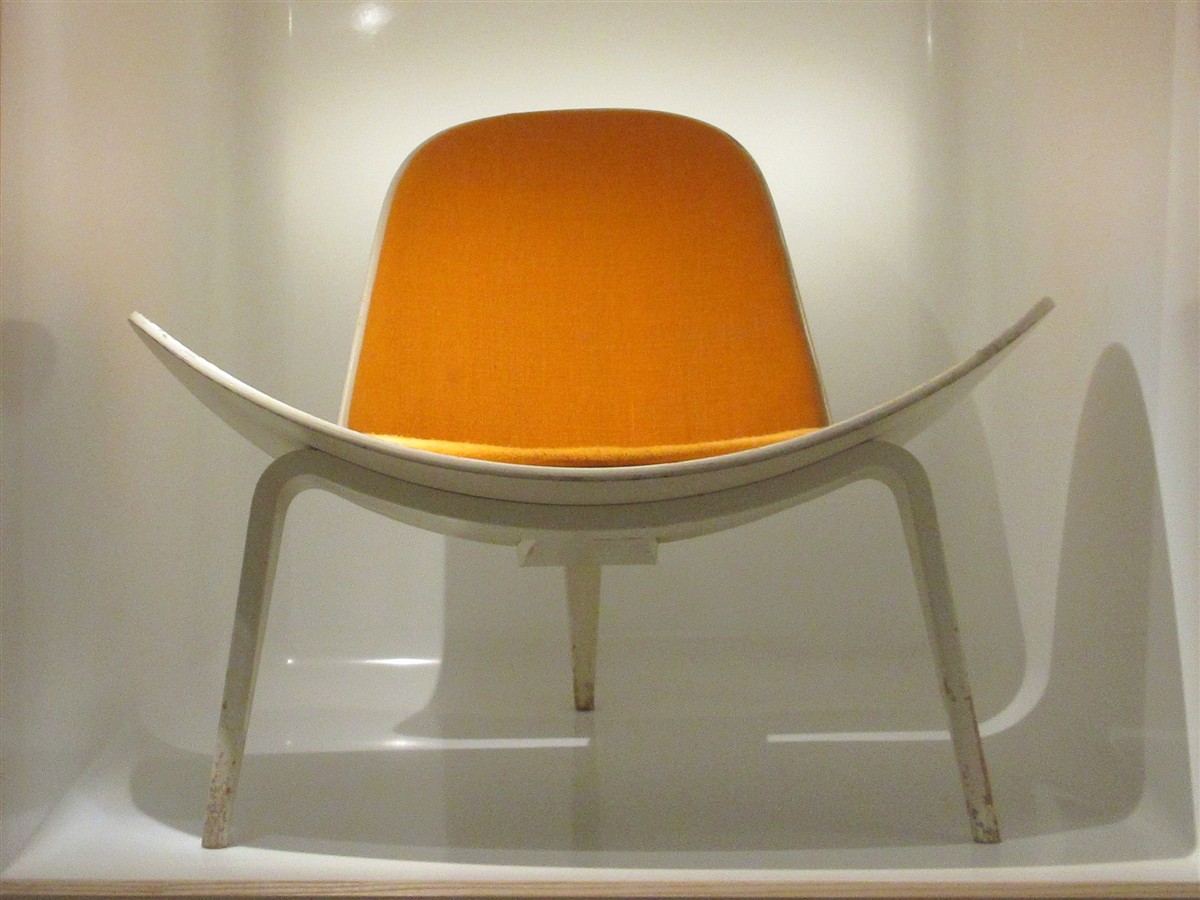
The Peacock Chair from 1947 takes the traditional English Windsor chair — stick legs, spindle back — and rebuilds it in teak with a wide fan of back spindles. The Flag Halyard Chair from 1950 uses sailing rope wound around a steel frame, low-slung and almost architectural in its horizontality. The Shell Chair from 1963 is a single curved plywood shell on four legs. The Ox Chair from 1960 has wide, projecting headrests that do actually resemble horns. Each of these is recognizably Danish, recognizably Wegner, and completely different from the others.
What they share is an interest in the human body. Wegner was not designing chairs as objects — he was designing chairs as things people would sit in for long periods, at different times of day, in different moods. He tested his chairs extensively by sitting in them himself and by watching others sit in them. The Wishbone Chair, famously comfortable, works because the Y-back supports the shoulder blades in exactly the right position. Getting that right required understanding not just wood and joinery but the geometry of the seated human body.
The Workshop Relationship
Wegner worked for most of his career with two Danish manufacturers: PP Møbler and Carl Hansen & Søn. These were workshop-scale operations, not factories, and the relationship between designer and maker was intimate. Wegner could — and did — revise designs in response to what the craftspeople found difficult or impossible. Drawings became prototypes, prototypes became conversations, conversations became the final piece.
This is a different model from the one Jean Prouvé worked in, where the constraint was industrial manufacturing, or the one Alvar Aalto used, where steam-bent plywood was both the material and the point. Wegner's constraint was the skilled hand: what could be made, beautifully, by someone who had spent years learning to work with wood. The answer turned out to be quite a lot.
After the Debate
The Kennedy-Nixon chairs were Round Chairs, model PP501. After 1960 the chair was in continuous demand in the United States, and Danish Modern became a recognized style in American interiors. Wegner continued designing until the late 1990s, winning the Lunning Prize in 1951 and the Danish Furniture Prize in 1997 among many others.
He was, by most accounts, a quiet and modest person who found the celebrity dimension of design slightly beside the point. He had designed a good chair. The television had made it famous. These were separate facts that didn't have much to do with each other. He kept working.