Alvar Aalto: The Finn Who Bent Wood for Tuberculosis Patients
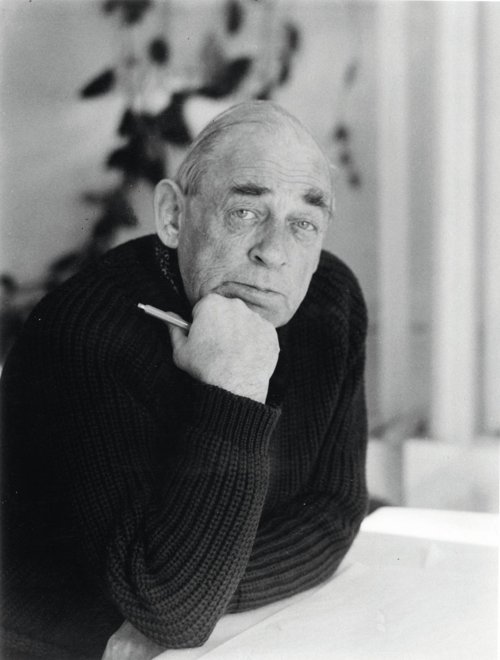
In 1929, Alvar Aalto won the commission to design the Paimio Sanatorium: a tuberculosis hospital in the Finnish countryside, south of Turku. He was 31. The timing was significant: tuberculosis was one of the leading causes of death in Finland, and the sanatorium was a serious institution with a serious brief.
The brief was also unusual in a way that shaped everything Aalto did for the next decade. He wasn't just designing a building. He was designing an environment where sick people could get better, which meant thinking about every detail, down to the washbasins, the door handles, the lighting, and the chairs.
The patients in his ward spent long hours sitting. The chair Aalto designed for them was engineered around one specific requirement: the sitting angle should make it easier to breathe. The back curves in a way that opens the chest. The frame is smooth birch plywood with no metal parts that could become cold in the Finnish climate. The design thinking that would define Aalto's work for the next forty years started with the question of how a sick person in a Finnish winter breathes.
From Kuortane to the World
Hugo Alvar Henrik Aalto was born in 1898 in Kuortane, a small town in western Finland. His father was a land surveyor. He studied architecture at the Helsinki Polytechnic, graduating in 1921, and set up practice in Jyväskylä, the town where he'd grown up after his family moved there.
Finland in the 1920s was twenty years old as an independent state, still finding its architectural identity. The dominant tradition was a Nordic national romanticism: stone buildings with heavy forms rooted in Finnish landscape and Finnish national mythology. Aalto looked at what was happening in Europe, read Le Corbusier, and decided that functionalism was the way forward. But his functionalism was never as abstract or geometric as the Europeans'. It was always inflected by the Finnish landscape: the birch forests, the lakes, the particular quality of northern light.
He and his wife Aino Marsio, whom he married in 1924 and who was an architect and designer in her own right, worked together from the start. Aino's contribution to the Aalto body of work is consistently underacknowledged: she co-designed much of the furniture and ran significant parts of their practice until her death in 1949.
Modernhaus documents mid-century modern design history in one place.
Explore the Design Archive →The Wood Problem
Aalto's furniture work grew out of a practical problem. He needed furniture for the Paimio Sanatorium that was affordable, durable, hygienic (metal and leather were difficult to clean), and comfortable for long-duration sitting. The solution he arrived at was bent birch plywood.
The bending of plywood in simple curves had been done before. What Aalto was attempting was different: compound curves, organic shapes, forms that required the wood to bend in multiple directions simultaneously. The material resisted. Wood has grain, and grain limits how it can be bent without breaking.
Aalto worked with a furniture manufacturer in Turku, Otto Korhonen, for years on this problem. The eventual solution involved cutting kerfs (thin slots) in the plywood at the bend points, which allowed it to curve without splitting. The technique produced furniture with a softness of form that tubular steel couldn't achieve, and it was Finnish: birch, local material, warm to the touch.
The first successful piece was the Paimio Chair (1931-1932): a cantilevered seat and back made from a continuous loop of bent plywood, with the frame forming both the structural element and the visible surface. It looks like it should be too delicate to sit in. It holds weight with complete confidence.
The Company They Founded
In 1935, Aalto and Aino co-founded Artek with two partners: Maire Gullichsen and Nils-Gustav Hahl. The name combined "art" and "technology." The company's purpose was to manufacture and sell Aalto's furniture, but also to act as a kind of design education company: selling modern furniture as part of a broader argument for the modernist way of living.
Artek still exists. It operates from Helsinki and sells Aalto's designs, some of which have been in continuous production since the 1930s. Stool 60, designed in 1933, is among the most reproduced pieces of furniture in the world: three legs of bent birch, a round seat, no back. It stacks. It's light. It costs around $250 from Artek. It has been in production for ninety years.
The Vase That Came From a Competition
In 1936, an Alvar Aalto vase won a competition at the Paris World Exhibition. The brief was for glassware. What Aalto submitted was an organic, asymmetrical form: not a cylinder or a sphere or any regular geometric shape, but something that looks like it was formed by water finding its own level. The edges undulate. The profile is different from every angle.
The official name is Aalto Vase. It's also known as the Savoy Vase, because the Savoy Restaurant in Helsinki, which Aalto designed, used them. The form has been interpreted differently over the years by various manufacturers but the original blue-green glass version, made by Iittala, is still in production. It remains the most recognisable object in Finnish design and probably the most copied.
What makes it interesting is the tension between its organic form and its industrial production. The shape is free and flowing; making it in glass, consistently, at scale, requires precise molds and skilled glassblowers. The industrial and the organic are not in conflict here. They depend on each other: you can't make this free form without tight industrial control, and the industrial precision would mean nothing without the organic form to realise.
What Humanist Modernism Means
Aalto's relationship to the modernist project was always complicated by his insistence on the human. He believed in functionalism: buildings should serve their users, furniture should fit the body, design should solve real problems. But he didn't believe that the correct solution was always the most abstract or geometric one.
The Paimio Sanatorium is organized around sunlight and air in a way that Le Corbusier would have recognised: long patient wings oriented south, balconies for sun therapy, a plan that maximises fresh air. But the details are different. The windows are sized for patients lying in bed. The ceilings are painted in warm colours on the patient side of the room and cool colours on the ceiling above, to reduce visual fatigue. The washbasins are shaped so that water runs silently down the inside, not splashing onto the floor at 3am.
These details are not geometric or abstract. They require knowing how a sick person in a Finnish hospital experiences a room. Aalto knew this because he looked at the people who would use his buildings with the same intensity he brought to the structural problems.
He worked until 1976 and designed roughly 500 projects in his lifetime, around 300 of which were built. He died that year at 78. The Stool 60 is still being made. The vase is still in production. The Paimio Chair is in the permanent collections of MoMA and the Vitra Design Museum. The patients who breathed a little easier in those chairs are long gone, but the angle of the back remains.