Ikat Weaving: The Textile That Begins With Dye and Ends With a Blur
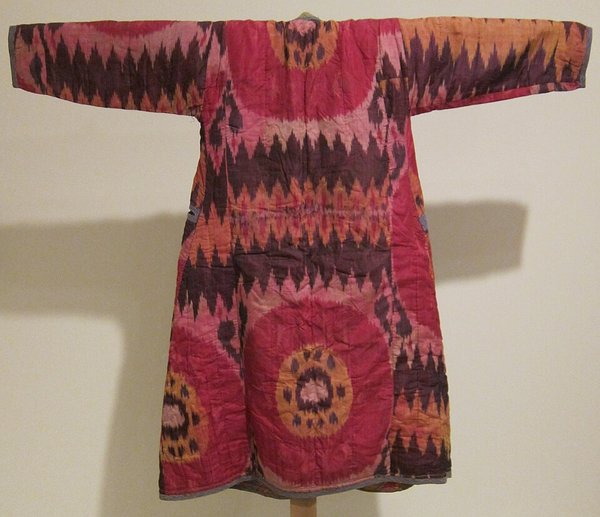
Most dyeing comes after weaving. You weave your cloth, then you dye it, then you have colored fabric. Ikat reverses this completely: you dye first, then weave, and the pattern in the finished cloth comes entirely from the arrangement of pre-dyed threads. The weaving itself is just the mechanism by which the pre-dyed threads are brought together.
This sounds simple, but the planning required to make it work is extraordinary. Before you can dye a single thread, you have to know exactly what the finished cloth will look like, which threads will cross which other threads at which points, and therefore exactly which sections of each thread need to be dyed which color. Resist-binding those sections before the dye bath, untieing them after, and then arranging everything correctly on the loom requires a spatial intelligence and a kind of four-dimensional planning that most weaving traditions never ask of their practitioners.
The word "ikat" comes from the Malay/Indonesian "mengikat," meaning to tie or bind. The technique appeared independently across multiple cultures: Central Asia, South and Southeast Asia, Central America, Japan, West Africa. The convergence suggests either very early diffusion or parallel invention, and textile historians argue the question with the same energy they bring to most things.
How the Pattern Arrives
In warp ikat, the vertical threads on the loom are pre-dyed in the pattern. The weft threads that weave through them are solid or neutral. The pattern appears in the warp. In weft ikat, the horizontal weaving threads are pre-dyed; the warp is plain. In double ikat, both warp and weft threads are pre-dyed, and the pattern depends on their precise alignment at every intersection.
Double ikat is the most technically demanding textile tradition in the world. The most famous examples are the patola of Patan, Gujarat, where a small number of families have maintained the tradition for at least five hundred years. A single patola sari can take months to weave. The patterns are extraordinarily complex geometric designs that look identical from front and back because every thread in both directions has been precisely dyed and precisely placed. There are perhaps a few dozen weavers in the world today who can make them to the traditional standard.
The other great double ikat tradition is geringsing from Tenganan Pegringsingan in Bali, a village that has been making this cloth for centuries and still does, using a natural dye palette that includes mordant-based processes and dye sources of great antiquity. Geringsing is considered sacred and is used in ritual contexts; it is one of the most protected textile traditions in Southeast Asia.
Modernhaus follows the thread from raw fiber to finished fabric.
Explore the Textile Studio →The Silk Road and Central Asian Ikat
The silk ikats of Central Asia, particularly from Uzbekistan and Tajikistan, are among the most visually spectacular textiles ever made. In the 19th century, Bukharan and Samarkand workshops produced silk ikats in colors that seem almost electric: intense oranges, crimsons, greens, and purples, often in large, painterly designs where the characteristic "ikat blur" at pattern edges becomes a feature of the design rather than an imperfection.
These pieces moved along trade routes across Asia and into Europe, and they were collected avidly by museums and wealthy individuals. The technique used cocoons of local silk and natural dyes including pomegranate rinds and other regional plant sources, which were already familiar materials in the dyeing traditions of the region.
The ikat blur is worth dwelling on. Because threads are bound and dyed before weaving, and because the resist-binding is never perfectly precise, and because the threads shift slightly in the weaving process, the edges of ikat patterns always have a soft, slightly feathered quality. In printed textiles, the edges are sharp. In woven textiles, the interlacement creates its own softening. In ikat, the blur is architectural: it's built into the technique at the deepest level. Some of the finest ikats exploit this deliberately, designing patterns where the blur creates movement and depth that a hard-edged print could never have.
Japanese Kasuri
In Japan, the technique is called kasuri, and it developed an aesthetic that diverged significantly from Central Asian and South Asian traditions. Japanese kasuri tends toward smaller, more restrained patterns, often geometric or pictorial designs woven in indigo blue on white cotton or hemp. The tradition was used for utilitarian everyday clothing as well as for fine fabric, and the kasuri kimono has a quality of quiet complexity: simple at a glance, intricate on examination.
Japanese indigo was the natural dye source for most kasuri, giving the characteristic deep blue that Japanese textile culture developed into an art form. The shibori traditions of Japan involve related resist-dye principles, though applied to finished cloth rather than to threads before weaving: both traditions share a way of thinking about pattern through selective dye application.
Making Ikat Today
Ikat is still being made in all its major traditions, from the patola weavers of Gujarat to the rug-weavers of Central Asia to Japanese kasuri workshops that have operated for generations. The technique has also been adopted by contemporary designers and fiber artists who appreciate precisely what makes it difficult: the way it requires a different kind of thinking, planning in four dimensions, committing to pattern before you can see it.
What you end up with is a textile that couldn't have been made any other way. The blur, the depth, the way color seems to vibrate at every edge, these aren't limitations of ikat. They're the signature of a technique that builds its meaning into the process before the first thread passes through the loom.