Natural Dye Mordants Explained: The Chemistry (and History) Behind Permanent Color
In 1462, a man named Giovanni de Castro was walking through the volcanic Tolfa hills west of Rome when he spotted white minerals with a familiar taste. Giovanni had spent years as a dyer in Constantinople before the city fell to the Ottomans in 1453, and he knew exactly what he was looking at.
He wrote to his godfather, Pope Pius II, in terms that only make sense if you understand how completely the European textile industry depended on a single mineral: "I announce to you a victory over the Turk. He draws yearly from the Christians above three hundred thousand gold pieces for the alum with which we dye our wool. I have, however, found seven hills so stocked with alum as to be nigh sufficient for seven worlds."
Pius II directed all profits to fund a crusade. The mines at Tolfa became the largest industrial enterprise in Europe, producing up to 1,500 tons of alum a year at their peak. The Medici family managed the early concessions and became significantly richer for it. The Christian fleet that defeated the Ottomans at Lepanto in 1571 was largely funded by Tolfa alum money. Between the 1500s and 1700s, the mines provided around 70% of papal wealth.
All of this because wool, without alum, loses its color in the wash.
What Mordants Actually Do
The word comes from the Latin mordere, to bite. Mordants bite into fiber at a molecular level, creating attachment points that dye molecules can grab and hold. Without them, most natural dyes are essentially sitting on the surface of the fiber rather than bonded to it. The color looks vivid when it comes out of the bath. Then it washes out.
Chemically, mordants are metal salts. Dissolved in water, they break into metal ions, which migrate into fiber and embed there. Dye molecules then bond to those metal ions rather than to the fiber itself. The metal is the bridge.
This is why the same plant produces completely different colors depending on which mordant is used.
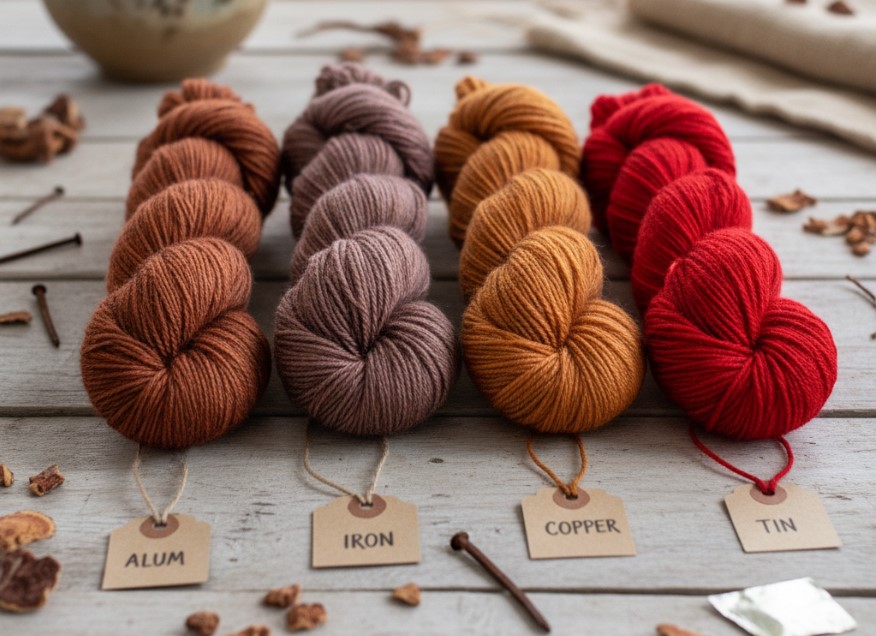
Madder root with alum makes brick red. Madder with iron produces purple-brown. Madder with copper shifts toward rust orange. Madder with tin comes out closer to scarlet. The dye molecule is identical in every case. What changes is the metal it's bonded to, and that changes how the molecule interacts with light at an electron level: absorbing different wavelengths, reflecting different colors back at your eye.
This is quantum chemistry made visible with wool and plant matter. And it means mordants aren't just fixatives. They're color modifiers. One dye plant with four different mordants is effectively four different dyes.
Modernhaus follows the thread from raw fiber to finished fabric.
Explore the Textile Studio →Alum: The One That Built Empires
Potassium aluminum sulfate is the most common mordant in natural dyeing, and has been for centuries. It's why Giovanni de Castro knew what he'd found in those hills. It's why the Ottoman control of Eastern alum supplies was a geopolitical problem serious enough for a Pope to call it a victory when European deposits turned up.
On protein fibers, wool and silk, alum works exceptionally well. It produces clear, bright color: the reds read as red, yellows as yellow, blues as blue. It doesn't shift hue the way iron or copper do. It fixes and clarifies.
Alum is also, relative to other mordants, benign. It's used in food processing and water treatment. The toxicity is low. This made it the accessible choice historically and keeps it the default starting point now.
On cellulose fibers, cotton and linen, alum alone is often insufficient. Their smooth structure resists metal ions. This is why tannin pre-treatment matters for plant-fiber dyeing, which we'll get to shortly.
Iron: The Saddener
Ferrous sulfate, iron mordant, darkens and mutes. Dyers call it a "saddening" agent, which is one of the better technical terms in textile chemistry. Yellow dyes become olive or grey-green. Reds shift toward burgundy. Blues deepen toward black. Iron removes brightness and pushes everything into the earth tones.
This is incredibly useful for anyone working toward subtle, complex colors rather than vibrant ones. Historical "black" dyes were often very dark browns or blues, overdyed and shifted as dark as possible with iron.
The tradeoff: iron degrades protein fiber over time. Not quickly, but measurably over years and decades. Some historical textiles dyed heavily with iron are more fragile than others for exactly this reason.
The concentration used for iron is typically much lower than for alum: a small amount shifts color dramatically. Used carefully as a post-dye modifier rather than a primary mordant, it can darken or adjust color without significant fiber risk.
Copper: The Green Maker
Copper sulfate shifts colors toward green and blue-green. Yellows become chartreuse or moss. Browns shift to olive. Some reds move toward rust. Copper creates the earthy greens that are genuinely difficult to achieve otherwise in natural dyeing.
Like iron, copper is harder on fiber than alum, and copper sulfate is more toxic to handle and to dispose of than either alum or iron. It's toxic to aquatic life in small concentrations, which means it can't simply be poured down a drain.
Some historical dyers used copper vessels rather than copper mordant: the pot surface releases copper ions during heating, which mordant the fiber and shift the color. Less precise, but requiring no additional chemicals.
Tin: The Brightener
Stannous chloride does the opposite of iron. Where iron saddens, tin intensifies. Yellows become more golden. Reds become more scarlet. Tin amplifies and saturates rather than shifting hue.
The cost is harshness: tin makes fiber brittle if overused. Stannous chloride is corrosive to handle. So it tends to be used sparingly, either at low concentrations or as a brief final dip after dyeing, what dyers call a "tin bloom," to brighten color without prolonged exposure to the fiber.
Historically, tin's intensifying effect was associated with expensive textiles. The more vibrant the color, the more you were signaling wealth. Which was sometimes the point.
Tannins: Not a Mordant, but Necessary
Tannins aren't metal mordants, but they're essential for natural dyeing on cotton and linen. Cellulose fibers resist metal ions because their smooth structure doesn't provide good attachment points. Tannins coat the fiber first with compounds that then accept metal mordants more readily.
Common tannin sources: oak galls, sumac, tea, black tea, and myrobalan. The fiber is treated with tannins before mordanting, which then allows the metal ions to bond to the cellulose. The sequence is tannin, then mordant, then dye.
Some natural dye plants are substantive on cellulose without mordants, meaning they bond directly without metal help. Indigo works differently again: the reduced form of the dye penetrates fiber and then oxidizes back to an insoluble pigment trapped inside the fiber structure. Black walnut stains fiber directly through tannins. But for most plant dyes on cotton, the tannin step is what makes color stick.
Chrome: The One We No Longer Use
Potassium dichromate was used widely in industrial and craft dyeing well into the mid-twentieth century. It produced excellent color permanence and a broad range of hues. Then the toxicity became impossible to ignore: chromium compounds are carcinogenic, environmentally persistent, and contaminate water in ways that can't be easily remediated.
Contemporary natural dyeing avoids chrome entirely. Historical recipes sometimes call for it. Those recipes are documentation of past practice, not current instruction.
Why Synthetic Dyes Don't Need Any of This
Synthetic dyes were engineered to bond to specific fibers directly. Fiber-reactive dyes form covalent bonds with cellulose. Acid dyes bond to protein fibers through ionic attraction. The bond mechanism is built into the dye molecule.
Natural dye molecules weren't optimized for fiber bonding. They evolved in plants for entirely different purposes: protection from UV, pollinator attraction, defense against insects. The fact that they produce color on fabric is, in a sense, accidental. Mordants compensate for the lack of a built-in bonding mechanism, creating the bridges the molecules don't have on their own.
This is also why synthetic dyes are generally more lightfast and washfast: the bond is stronger and more specific. Natural dyes with mordants approach but rarely match that permanence. The tradeoff is color character. Synthetic dyes produce pure, single-compound color. Natural dyes produce complex color because the dye is itself a complex mixture of compounds. Madder isn't one molecule. It's dozens of related molecules that together produce a red that no synthetic has ever quite replicated.
The Color That Fades Beautifully
"Permanent" in natural dyeing is relative. A well-mordanted natural dye on wool will last decades without significant fading under normal conditions. It won't wash out. But UV exposure breaks down dye molecules over time. Frequent washing gradually removes color. Abrasion wears it away.
The fading pattern is part of the aesthetic. Colors shift subtly over years. High-wear areas lighten first. The fibers develop a particular kind of character that synthetic-dyed fabric doesn't quite achieve, because the fading isn't uniform degradation but a gradual, differential aging.
Some natural dyes are more lightfast than others. Madder, weld, and indigo are known for excellent permanence. Turmeric and safflower fade quickly. The mordant improves permanence significantly, but it can't overcome an inherently unstable dye molecule. The metal salt bites into the fiber and holds the dye there. What it can't do is keep the dye molecule from breaking down when the light hits it long enough.
Giovanni de Castro understood alum's commercial value in terms of trade routes and papal finance. The chemistry behind why it works, the metal ions migrating into wool, providing bridges for dye molecules, creating electron configurations that reflect specific wavelengths of light, came much later. The outcome he recognized was the same: without alum, the reds faded. With it, they lasted.
The wool of fifteenth-century Florence was worth more because a displaced dyer recognized a mineral in the hills outside Rome. The same chemistry is still running in natural dye studios today.