George Nelson: The Man Who Didn't Design the Things That Made Him Famous
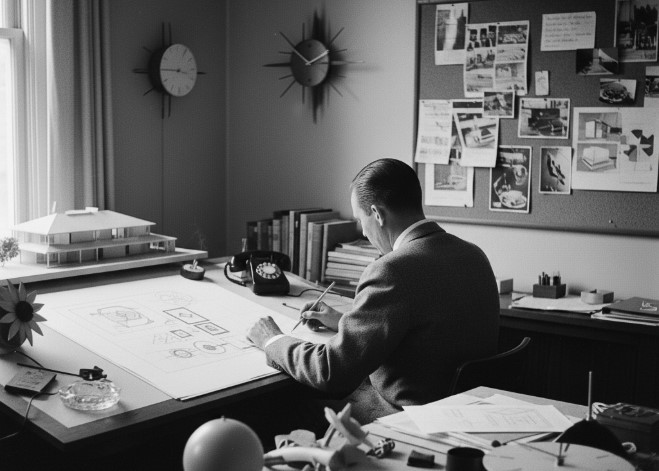
In 1947, four designers spent an evening at George Nelson's New York office sketching clock concepts and working through bottles of wine. The four were Nelson, Irving Harper, Buckminster Fuller, and Isamu Noguchi. They worked late. Designs were drawn. At some point, everyone went home.
Nelson came back the next morning and found a roll of drafting paper with the Ball Clock on it.
He couldn't say who'd drawn it. His best guess was Noguchi, "because he has a genius for doing two stupid things and making something extraordinary out of the combination." Harper later confirmed it was probably his own work, or at least that he'd drawn the final version. The clock went into production through Howard Miller in 1949, and Nelson recalled years later that "every ad that showed a kitchen for years after that had a ball clock in it." It is now in the permanent collection of the Art Institute of Chicago, sits in design museum gift shops worldwide, and costs around $395 new from Vitra.
Nobody is entirely sure who drew it.
This is, in a way, the whole George Nelson story in a single anecdote. The most recognized piece of his legacy might not be his. That's not a scandal. It might actually be the point.
The Writer Who Stumbled Into a Job
Hartford, Connecticut, 1908. Nelson grew up working in his parents' drugstore. Got through Yale studying architecture. Won the Rome Prize in 1932, which came with a healthy stipend and accommodation in a palace, and spent two years in Europe doing something unusual for an American design student at the time: he went and interviewed the modernists directly.
Le Corbusier. Mies van der Rohe. Gio Ponti. Walter Gropius. He wrote up what he found for Pencil Points and Architectural Forum, essentially introducing the European modernist movement to North American readers. He was 24. He had a talent for noticing what mattered and explaining it clearly, which would turn out to be worth considerably more than a talent for drawing chairs.
Back in America, he kept writing. In 1945, he co-authored Tomorrow's House with Henry Wright, a book about designing homes to meet the actual requirements of modern life rather than copying historical styles. The book introduced the concept of the "family room" to American residential architecture: not the formal living room you kept for guests and never used, but a space where people actually lived. The idea sounds obvious now. In 1945, it was a genuine proposal.
D.J. De Pree, chairman of Herman Miller, read it. Herman Miller at the time was making safe, conventional wood furniture: the kind of thing nobody remembered and nobody particularly wanted. De Pree had been looking for someone who understood where design needed to go. He found the article Nelson had written blasting the American furniture industry for being exactly what Herman Miller was. De Pree read the criticism and offered Nelson the job of design director in 1947.
Nelson had never designed furniture. De Pree knew this. It didn't matter. What he wanted wasn't someone who could draw chairs. He wanted someone who understood what was wrong and knew what right looked like. The contract gave Nelson freedom to work outside Herman Miller and to source designs from other architects.
Nelson took the job and immediately started recruiting.
Modernhaus documents mid-century modern design history in one place.
Explore the Design Archive →What He Actually Did
Charles and Ray Eames. Isamu Noguchi. Alexander Girard. Harry Bertoia. These are the people Nelson brought to Herman Miller in the late 1940s and 1950s. Each of them actually knew how to design furniture. Nelson's job was to find them, connect them to the right problems, and make sure the results got made and sold.
He described his role, in various interviews over the years, as something closer to conductor than musician. He understood the whole score. He knew which instrument should play when. He was not himself playing anything.
This is not a diminishment. Building an environment where that much talent can work is a specific and difficult skill, and Nelson had it. Herman Miller under his direction became the company that produced the Eames Lounge Chair, the Noguchi coffee table, the Bertoia wire chairs, and Girard's textile work. All of that happened because Nelson was in the room, making the connections, arguing for the right projects, keeping the company's direction coherent.
His own studio, George Nelson Associates, ran parallel to his Herman Miller work. And that studio also employed remarkable people, most notably Irving Harper, who joined early and stayed for nearly two decades.
The Bubble Lamp and the Liberty Ships
Here is a story that belongs unambiguously to Nelson himself.
In 1947, he wanted spherical hanging lamps for his New York office. Found beautiful ones imported from Sweden, covered in stretched silk. They were $125 each and required workers to cut silk gores by hand and sew them onto wire frames, a process so labor-intensive that the price was essentially irreducible.
Around the same time, he saw a photograph in the New York Times. Liberty ships, being put into storage after the war, were being covered in protective netting and then sprayed with a self-webbing plastic that dried into a hard shell. Nelson looked at that image and thought about lamps.
He tracked down the manufacturer of the spray. Within days he had a process: form a wire frame into whatever shape you wanted, spin it on a turntable, shoot translucent plastic at it until the coating was complete, remove the internal form, add a light socket. The plastic webbed itself into a durable translucent skin. No cutting, no sewing, no specialist skills required.
The first Bubble Lamps went into production through Howard Miller Clock Company in 1952. Nelson created over a dozen variations, each one a different wire frame shape with the same spray-coated finish: Apple, Pear, Saucer, Cigar, Lotus. The manufacturing process was identical across all of them. The apparent variety cost almost nothing extra to produce.
The lamps stayed in production through 1979, came back in the late 1990s when mid-century design resurged, and are currently made by Herman Miller. They appear in MoMA's permanent collection. Current retail runs from $300 to $500 depending on size.
That flash of lateral thinking, seeing a military preservation technique and immediately knowing it was a lighting solution, is Nelson's individual genius in its clearest form. He wasn't drawing objects. He was recognizing possibilities that other people looked past.
Harper's Weekend
In 1954, a salesman visited George Nelson Associates with a product: self-skinning vinyl discs, twelve inches in diameter, that formed their own outer layer during molding. Durable, cost-effective, no upholstering required. Revolutionary, according to the salesman.
Nelson saw furniture potential. He gave the discs to Irving Harper.
Harper took them, and over a weekend designed what became the Marshmallow Sofa: eighteen circular cushions arranged in a playful, offset pattern over a tubular steel frame. The cushions looked as though they were floating. The whole thing looked like Pop Art before Pop Art had a name.
The salesman's product did not perform as advertised. The discs were not actually self-skinning in production. Herman Miller had to upholster each of the eighteen cushions individually by hand. What was supposed to be a budget manufacturing breakthrough became labor-intensive luxury production. Herman Miller made only 186 Marshmallow sofas in the initial run, from 1956 to 1961. The economics were untenable.
Original examples now sell for $15,000 to $37,500 depending on condition and provenance. Herman Miller reissued the design in the 1980s and still produces it. Current retail sits around $8,000 to $10,000 in leather. Still hand-assembled, because there is no other way to do it.
A weekend sketch. One hundred and eighty-six units. Decades of museum appearances. A sofa that costs roughly what a used car costs to make.
All of it credited, for most of its life, to George Nelson.
The Office Everyone Hates
In 1964, Robert Propst, working at George Nelson Associates, designed the Action Office system: modular furniture built around movable panels, adjustable-height desks, and flexible storage. The idea was to give office workers control over their immediate environment. Privacy screens when you needed to concentrate. Open configurations when you needed to collaborate. Personalized workspaces instead of institutional rows of identical desks.
The concept was genuinely revolutionary. Herman Miller put it into production. It won a major design award. Nelson received the award.
Companies bought the Action Office in enormous quantities. Then used it in the way that maximizes workers per square foot and minimizes cost per person. The movable panels became permanent walls. The flexible configurations became fixed cubicle grids. The system designed to give workers autonomy became the architecture of surveillance and space compression.
The modern office cubicle, which Propst later described as a "monolithic insanity," descends directly from his flexible workspace system. Good intentions, bad implementation, credit attributed to the wrong person for a design that got misapplied anyway.
What Harper Said After Nelson Died
Irving Harper worked at George Nelson Associates for nearly two decades. He designed most of the Howard Miller clock collection, the Marshmallow Sofa, and the Herman Miller logo, among dozens of other pieces. His name appeared in trade publications. Consumer marketing said "George Nelson."
While Nelson was alive, Harper didn't push back. The studio system was the deal; he understood it and accepted it. Nelson died in 1986. A few years later, Harper started quietly correcting the record. In a 2001 interview with Metropolis, he said: "While he was alive, I made no demands whatsoever, but now that he's gone, whenever the Marshmallow Sofa is referred to as a 'George Nelson design', it sort of gets to me. I don't go out of my way to set things right, but if anybody asks me who designed it, I'm perfectly happy to tell them."
He also said this about Nelson: "He was like Diaghilev, able to locate talents who were brilliant in their own way, allowing them to flourish." That comparison to the Russian ballet impresario who enabled everyone around him but created nothing himself is, depending on how you read it, either a generous tribute or an extremely precise verdict.
The Art Institute of Chicago now credits Irving Harper as designer of the Ball Clock in their permanent collection documentation. Vitra acknowledges his role in their archival materials. Herman Miller's consumer marketing still says George Nelson, because that is the brand people search for.
Harper spent his retirement making elaborate paper sculptures, hundreds of them, which were exhibited and celebrated. Work that was entirely his own, credited entirely to him. He died in 2015, aged 99, in Rye, New York.
The Numbers
Nelson's archival estate, around 7,400 manuscripts, drawings, and photographs, went to Vitra Design Museum after his death in 1986. Vitra began reissuing Nelson designs in 1999. Herman Miller continues producing the furniture and lighting.
The Bubble Lamps retail at $300 to $500. The Marshmallow Sofa runs to $9,000. The Coconut Chair, designed by George Mulhauser at Nelson's studio, sits around $4,000. The Ball Clock costs $395 from Vitra, and several hundred dollars less from the reproduction manufacturers who have been copying it since the patents expired.
What Nelson actually left behind is harder to price than any of those objects. He introduced European modernism to American readers. He invented the family room. He built the environment that produced some of the most recognizable furniture of the twentieth century. He recognized talent and gave it room to work.
Whether any of that makes up for four decades of Irving Harper designing things credited to someone else is a question the furniture itself can't answer. The furniture just keeps selling.