Lichen Dye: The Slow Color from Rock and Bark
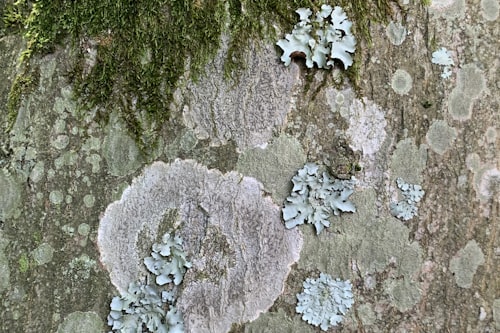
Lichens are not plants. They are composite organisms — a fungus and a photosynthetic partner (usually an algae or cyanobacterium) living in a mutualistic relationship so intimate that the two cannot survive independently. They grow on rocks, bark, soil, and glass, producing flat crusts, branching shrubs, and hanging filaments. They grow slowly — some crustose lichens add less than a millimeter of diameter per year — and they produce chemical compounds found nowhere else in nature.
Several of those compounds are dyes, and a few produce colors of extraordinary depth and character.
The Two Methods
Lichen dyes divide into two groups based on how the color is extracted.
The first group — including the crotals, the Parmelia lichens that cover rocks across Scotland and Scandinavia — yield brown and warm orange colors by simple simmering. The lichen goes into the dye bath with the fiber, water is added, and the pot is heated. The color comes out without mordant. Browns from crotal are warm, earthy, and lightfast enough to be used commercially.
The second group — the orchil lichens, primarily Ochrolechia and Roccella species — produce vivid purples, crimson, and red through an ammonia fermentation process. The lichen is combined with stale urine (or ammonia solution) and left to ferment, covered, for two to four weeks with daily stirring. The liquid turns purple-red through a process that was not chemically understood until the nineteenth century. The resulting dye bath colors wool in shades ranging from mauve to deep purple depending on the lichen species and fermentation conditions.
Modernhaus follows the thread from raw fiber to finished fabric.
Explore the Textile Studio →Orchil and the Trade in Purple
The orchil dye tradition is ancient. Pliny the Elder mentions it. Medieval Italian merchants traded dried orchil lichens — called orseille in French, orsello in Italian — as a commercial dyestuff. Florentine merchants controlled much of the orchil trade in the thirteenth and fourteenth centuries, importing the lichens from the Canary Islands and the Azores. The color was used to achieve cheaper imitations of Tyrian purple — the mollusc-derived dye reserved for emperors — and was frequently mixed with madder or woad to extend and modify the color.
The Faroe Islands and the Outer Hebrides of Scotland had their own traditions of orchil-type fermentation using local lichen species. The Gaelic word crottle (anglicized to "crotal") referred broadly to lichens used for dyeing, and the color these yielded was considered characteristic of the region's textiles.
Harris Tweed
Harris Tweed — the handwoven wool cloth produced in the Outer Hebrides of Scotland, protected since 1993 by the Harris Tweed Act — carries a characteristic smell that many wearers describe as peaty, earthy, or simply Scottish. That smell comes partly from the water used in processing and partly from crotal lichen, still used by some traditional Harris Tweed dyers to achieve the warm buff and brown tones considered authentic to the cloth.
The relationship between lichen dye and Harris Tweed is one of the stranger survivals in commercial textile production: an ancient foraging and fermentation practice persisting within a legally protected craft industry in the twenty-first century.
Gathering and Sustainability
Lichen grows slowly. The crotals that a weaver might gather from a rock face in an afternoon could represent decades of growth. Commercial harvesting of orchil lichens in the Canary Islands and Cape Verde in the nineteenth century was unsustainable — populations were significantly depleted. The trade shifted to synthetic dyes (mauveine, the first synthetic dye, was essentially a synthetic orchil) as lichen became scarcer and more expensive.
Contemporary natural dyers who work with lichen generally advocate gathering only what falls naturally from trees and rocks after storms, rather than scraping lichen from living surfaces. The slow growth rate makes selective harvesting the only ecologically defensible approach.
The connection to natural dye mordants is minimal with orchil — the fermentation method is mordant-free, which is genuinely unusual among natural dyes and was part of what made orchil commercially attractive. Most natural dye reds require mordanting; orchil does not. The tradeoff is the weeks of fermentation and the smell of the process, which contemporaries described as considerable.