Anni Albers: The Weaver the Bauhaus Didn't Mean to Make
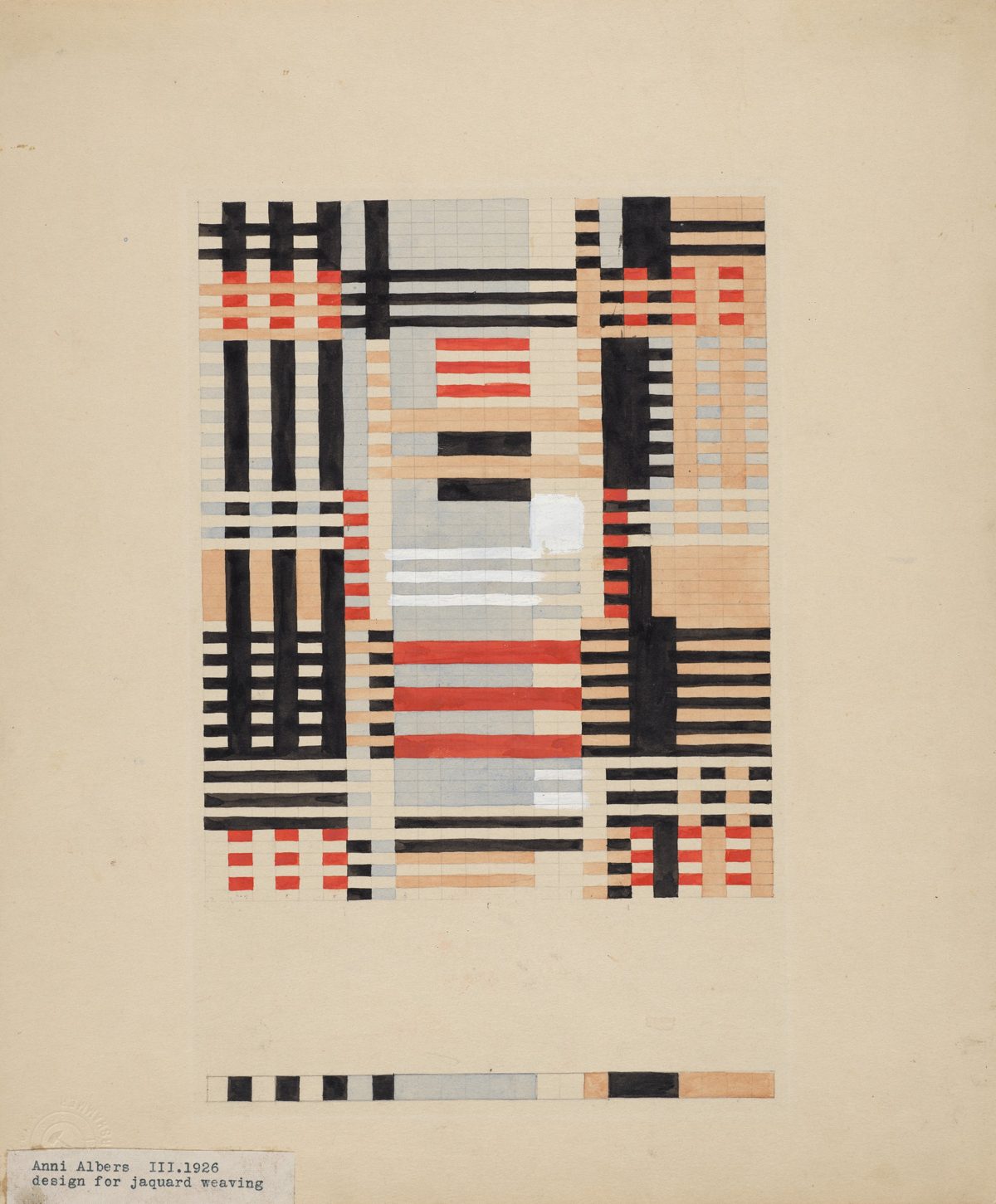
The Bauhaus had a rule. Walter Gropius wrote it into the founding prospectus in 1919: no distinction between the sexes. Every workshop, every craft, every discipline open to anyone who could pass the entrance requirements. It was one of the more radical statements in the history of design education.
Then the women showed up, and Gropius quietly redirected them toward the weaving workshop.
Anni Fleischmann arrived in 1922. She wanted Paul Klee's painting class. She ended up at a loom. Not because she asked. Because the administration looked at her and reached a conclusion that had nothing to do with her abilities and everything to do with 1922. Weaving was soft. Weaving was domestic. Weaving was, and this is the actual logic that was used, biologically suited to women's hands.
This is important context for what comes next: the woman they sent to the weaving workshop went on to have a solo exhibition at the Museum of Modern Art in 1949, the first textile designer in the institution's history to receive one. Her textbook On Weaving (1965) is still taught in design schools. Her prints command five-figure sums at auction; original wall hangings appear in the permanent collections of MoMA, the Metropolitan Museum, the Tate, and the Harvard Art Museums. Josef Albers, whom she married in 1925, is remembered as one of the great colorists of the twentieth century. Anni is remembered as one of the great designers, full stop.
The loom they pointed her toward turned out to be right. For the wrong reasons, entirely.
She Arrived at the Bauhaus Already Knowing Things
Annelise Elsa Frieda Fleischmann was born in Berlin in 1899. Her father ran a furniture manufacturing business. Her mother came from the family that owned Ullstein Verlag, the largest publisher in Germany. She grew up in a household where design, aesthetics, and print were not abstract concepts but the actual material of daily life.
Before the Bauhaus she studied art in Hamburg under Jan Thorn-Prikker, and briefly in Munich. She wasn't arriving at Weimar as a blank canvas — she knew what she wanted, which was painting, and she had the training to pursue it. The administration's decision to redirect her was not based on an assessment of her skills. It was based on the number of women already enrolled in fine art courses and the institutional assumption that there were natural limits to that number.
Gunta Stölzl was running the weaving workshop when Anni arrived. She was one of the very few women at the Bauhaus to hold any kind of authority, and she ran the workshop with the rigor of someone who understood that weaving had to prove itself as a design discipline before it would be taken seriously. Under Stölzl, the workshop was not doing decorative craft. It was doing material research: testing fibers for tensile strength, light reflection, acoustic properties, color fastness. The loom was a laboratory.
Paul Klee taught color theory in the building. Wassily Kandinsky was down the hall. And something about the structure of weaving — the fundamental logic of warp and weft, the way a fabric's behavior emerges entirely from the relationship between threads — connected to the way Anni thought. She has described the moment of recognition as happening slowly, then completely. The medium she'd been assigned turned out to be the right one.
Modernhaus documents mid-century modern design history in one place.
Explore the Design Archive →The Curtain That Got Her Degree
In 1930, Anni Albers completed her Bauhaus diploma. The project was a wall covering for the auditorium of the ADGB trade union school in Bernau, designed by Hannes Meyer — at that point the Bauhaus's director, a committed functionalist who wanted design to solve actual problems rather than decorate surfaces.
The problem she was given was genuinely technical: the auditorium needed a wall covering that absorbed sound and reflected light simultaneously. These are, in material terms, opposing requirements. Sound absorption wants soft, porous, rough surfaces. Light reflection wants hard, smooth, specular ones.
Her solution was cotton and cellophane woven together, with a chenille component for the acoustic layer. The cellophane — then a new industrial material, barely a decade old — handled the reflection. The chenille handled the absorption. The structure of the weave mediated between them.
This is not decoration. This is engineering conducted through the medium of textile. The distinction matters, because the Bauhaus was supposed to dissolve exactly this kind of boundary between art and technical problem-solving — and here was the weaving workshop doing it as thoroughly as any metalwork or carpentry class. The curtain was installed in the auditorium. It worked.
When Gunta Stölzl resigned from the Bauhaus in 1931, Anni Albers became head of the weaving workshop. She was 32 and had spent nine years in the discipline that implicitly didn't quite count. She was now running it.
The Bauhaus closed two years later, in 1933, under pressure from the National Socialists. Mies van der Rohe, who had taken over the directorship, shuttered it rather than let it be dismantled from inside. The faculty scattered. Josef and Anni Albers, both Jewish, had no particular reason to stay in Germany.
Black Mountain College, North Carolina
Philip Johnson — then 27 and not yet the Philip Johnson — was in Germany visiting the Bauhaus when it closed. He passed the Alberses' names to a new experimental college in the mountains of North Carolina that was looking for faculty. Black Mountain College had been founded that same year on the principle that art and craft were central to education rather than peripheral to it. It had no accreditation, no permanent buildings, and essentially no money. It also had, from 1933 onward, two of the finest design educators alive.
Josef ran the foundation course and the painting program. Anni ran weaving, and the weavers at Black Mountain learned the same thing her students at the Bauhaus had learned: that a loom is not a device for making decorative objects but a system for exploring the behavior of materials under tension. The rigid heddle loom that feels like a modest beginner's tool connects directly to this tradition — the logic of interlacing threads is the same whether the loom cost $200 or is mounted in a museum.
What changed at Black Mountain was the geography. The American Southeast was not Weimar or Dessau, and the Alberses were not sealed inside a design school anymore. They traveled. Mexico became a regular destination. Then Peru. Then Chile.
The Warehouse in Mexico City
The first time Anni Albers saw pre-Columbian textiles in person, she was in a Mexican market. What she found there rewired her understanding of what weaving could be.
The weavers of ancient Peru had operated without a written language. Communication happened through cloth: through color sequences, structural patterns, the particular way threads interlaced in a specific region or for a specific ceremonial purpose. The textiles were not decorative. They were language — carrying information the way writing carries it, encoded in structure rather than symbol.
Albers began collecting fragments. She worked with museum collections in Mexico and Peru, studying technique and structure with the rigor she'd applied to cellophane and chenille at Bernau. She identified weaving methods — the backstrap loom in particular, which places the entire tension of the warp against the weaver's own body — that produced structural effects impossible on the floor looms she'd learned on.
The influence appeared directly in her work. Ancient Writing (1935) was the first in a series of pictorial weavings: Haiku (1961), Code (1962), Epitaph (1968). The titles are not metaphors. She was making textiles that functioned as texts, encoding meaning in structure the way Andean weavers had done for thousands of years before the Spanish arrived and burned most of what existed.
When she finally published On Weaving in 1965, the dedication read: "To my great teachers, the weavers of ancient Peru." Not to Klee. Not to Gropius. Not to Stölzl. To the unnamed people who had solved, millennia earlier, the problem of making cloth that communicates.
September 14, 1949
The MoMA exhibition opened on a Tuesday. It ran until November 6 and then traveled to 26 museums across the United States and Canada over the following two years.
The Museum of Modern Art had opened its textile collection in the 1930s but had not, in its first two decades, given a solo exhibition to a textile designer. The medium was considered craft: technically accomplished, culturally valuable, but not quite art in the way that painting and sculpture were art. Anni Albers had been making the case, through her work at Black Mountain and her published writing, that this distinction was a category error.
The exhibition was the institutional acknowledgement that she had won the argument, at least partially.
The show included wall hangings, pictorial weavings, and examples of her industrial textile work — fabrics produced for commercial manufacture that carried the same structural thinking as her one-off pieces. She had been designing for industry throughout the 1940s: upholstery fabrics, drapery material, wallcoverings. The exhibition made the continuity between those two modes of working visible in one place.
She was 50. The Bauhaus had been closed for sixteen years. The weaving workshop that had been the soft option was now the subject of a solo show at the most influential modern art museum in the world.
The Printmaking Turn
After leaving Black Mountain in 1949 — Josef had been appointed to the design faculty at Yale, and they moved to Connecticut — Anni gradually shifted her attention toward printmaking. The reasons were partly practical: weaving is slow, physically demanding, and materially expensive in a way that lithography and screenprinting are not. But the shift was also creative.
What she found in printmaking was that the lithographic surface behaved like a woven structure if you treated it that way. Lines could interlace. Patterns could be built through repetition and variation of a single element, the way warp and weft build cloth. The grid that underlies all weaving reappeared in the geometry of her prints. She described treating the lithographic stone as if she were weaving it: lines engaging and knotting the way fibers do in a textile structure.
The prints reached a wider audience than the wall hangings ever had, partly through lower price points and partly through sustained gallery promotion of her work from the 1990s onward. The Tate Modern retrospective in 2018 — 350 works, the most comprehensive survey of her career assembled in one place — drove significant critical reappraisal. Work that had been accessible to collectors for relatively modest sums in the 1980s and 1990s reached five and six figures as the Bauhaus centenary in 2019 focused international attention on the school's full scope.
What On Weaving Actually Says
On Weaving (1965) is, on its surface, a technical manual. It explains the mechanics of woven cloth: how plain weave works, how twill differs from it, how pattern emerges from the deliberate manipulation of thread sequences. A student learning to weave can use it as a practical guide.
It is also, less obviously, a philosophy of materials. Albers argues that understanding a medium at the physical level — knowing what thread does under tension, what happens to a surface when you change the weave angle, how structure produces both form and meaning — is not preliminary work before the real thinking starts. It is the thinking. The hand that learns how fiber behaves is not separate from the mind that makes design decisions. They are the same faculty.
This is the Bauhaus workshop model restated in theoretical terms: craft knowledge is not subordinate to design knowledge. They are the same thing approached from different directions.
The book dedicated to the Peruvian weavers is making an argument about them. The people who built textile languages without writing were not doing something simpler than what Klee was doing at a canvas. They were doing something at least as complex, in a medium that had not, until Albers insisted, received equivalent critical attention.
The Numbers
On Weaving remains in print. On Designing (1959) remains in print. Her work is in the permanent collections of MoMA, the Tate, the Metropolitan Museum of Art, the Harvard Art Museums, the Smithsonian, and the Bauhaus-Archiv in Berlin.
Her prints trade regularly at auction: screenprints and lithographs from the 1960s and 1970s appear at $2,000–$15,000 depending on edition, condition, and subject. Original weavings from the Bauhaus and Black Mountain periods are museum-held almost without exception; the rare pieces that do appear at auction reach the upper end of five figures.
The 2018 Tate retrospective drew over 170,000 visitors across fourteen weeks. The accompanying catalog sold out in its first months. The exhibition traveled to the Kunstsammlung Nordrhein-Westfalen in Düsseldorf in 2019, timed precisely to the Bauhaus centenary.
What those attendance numbers represent, more than market value, is the delayed recognition of something that had been there all along: a designer who worked at the intersection of ancient craft and modernist theory, who understood both the Bauhaus and the backstrap loom, and who spent sixty years arguing that what she was doing with thread was as serious as anything being done with paint.
The Bauhaus redirected her to weaving because they thought it was the lesser option. The record — the exhibitions, the collections, the textbooks still in print — makes that error visible with every wall hanging that ends up behind museum glass.
She died in May 1994 in Orange, Connecticut, age 94. She had outlived Josef by ten years, outlived most of the Bauhaus, outlived several of the museums that had declined to take her medium seriously. On Weaving was still in print. The looms at Black Mountain were gone, but what she had taught there — that fiber has structure and structure carries meaning — was inside the practice of every weaver who had been told that weaving was the soft option and kept going anyway.