Shibori Dyeing: Japan's Thousand-Year Tradition of Shaped Resist
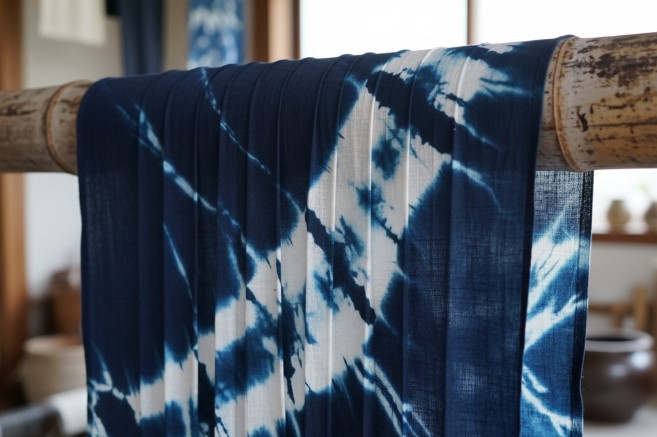
In 756 CE, when the Emperor Shōmu of Japan died, his widow donated his personal belongings to the Tōdai-ji Buddhist temple in Nara. Among the textiles she gave: cloth dyed using bound resists, folded and clamped resists, and wax resists. Those pieces are still there. The Shōsōin treasure house has preserved them for nearly thirteen centuries, making them among the oldest surviving examples of what we now call shibori.
The word itself comes from the Japanese verb shiboru, which means to wring, to squeeze, to press. The family of techniques it names all work by the same logic: reshape the cloth before dyeing, and the dye can only reach the parts you've left accessible. Untie, unfold, or unclamp it afterward, and the parts that were compressed emerge undyed, white against the dyed ground.
Simple enough in principle. What makes shibori extraordinary is how many different ways there are to reshape cloth before dyeing, and how completely different the resulting patterns are.
The Six Families
Kanoko is the one Westerners typically encounter first, because it looks like tie-dye. Small sections of cloth are picked up and bound tightly with thread, creating pinch-points that resist the dye. The name means "fawn spots": the rings and dots it produces resemble the spotted coat of a young deer. Kanoko shibori on silk, using fine untwisted thread and perfect small bindings, is among the most labour-intensive textiles made anywhere in the world. A single kimono in kanoko could take a skilled craftsperson years.
Miura is similar: loops of cloth are picked up with a hook and bound loosely with thread. Less labour-intensive than kanoko. The resulting pattern is softer and more irregular.
Nui involves stitching the cloth with running stitch before pulling the thread tight, gathering the fabric along the stitching line. The gathered sections resist dye. When the stitches are removed, the dye reveals the stitch pattern as negative space. Curved lines, straight lines, spirals: the stitch path determines the shape that emerges.
Arashi means storm. Cloth is wrapped diagonally around a pole, bound with thread along the pole's length, then compressed down the pole before dyeing. The diagonal wrapping and compression create a pattern of diagonal lines, sometimes regular, sometimes varied. The name describes what the pattern looks like: rainfall, driving diagonally across the cloth.
Itajime is the most geometric. Cloth is folded accordion-style, or into triangles, then clamped between wooden or metal blocks. The blocks resist the dye wherever they press against the fabric. The folded geometry determines the symmetry of the pattern: fold into a triangle, get a triangle-based repeat. The precision of itajime depends on the precision of the folding.
Kumo involves pleating the fabric in specific ways and binding the pleated sections. The resulting pattern is typically a series of pebble-like circles or asterisks.
These techniques can be used individually or in combination. Cloth that has been nui-stitched, then arashi-wrapped, then dipped in an indigo vat will carry both patterns simultaneously.
Modernhaus follows the thread from raw fiber to finished fabric.
Explore the Textile Studio →Indigo and the Blue That Doesn't Fade
The dye most historically associated with shibori is indigo. Japanese craftspeople working in shibori used indigo almost exclusively for centuries, in part because of its deep blue colour, in part because of a practical advantage that would have mattered considerably to the people wearing the cloth: indigo has natural antiseptic properties. Indigo-dyed workwear was thought to repel insects and resist infection. Farmers, fishermen, and firefighters wore deep indigo blue.
The shibori tradition developed most fully in the Edo period (1615-1868), when the Tokugawa government's strict sumptuary laws restricted the colours and materials available to commoners. You couldn't wear silk if you were a merchant. You couldn't wear bright red or purple. But you could wear cotton dyed in indigo, and the ingenuity that went into making that plain blue cloth extraordinary through pattern and resist is part of what drove the extraordinary refinement of shibori technique during those two centuries.
Arimatsu, a small town near Nagoya, became the most famous centre of shibori production. It still is. Arimatsu craftspeople have been producing shibori textiles since the early 1600s. The town has a museum dedicated to the tradition, and production continues, though the workforce has shrunk dramatically from its nineteenth-century peak.
What Shibori Is Not
The 2010s saw "shibori" become a fashion and craft trend in the West, which generated considerable confusion about what the word actually refers to. Tie-dye made with chemical dyes is not shibori, though it uses related resist principles. Fabric folded and dipped in diluted dye is not shibori. The techniques and the name carry specific meanings in Japanese craft tradition that don't simply transfer to casual Western approximation.
This is worth noting not as gatekeeping but as useful precision. The actual techniques, applied with proper materials and care, produce patterns that casual approximations don't approach. The kanoko shibori kimono that took years to make has a surface quality that's unmistakable. The arashi shibori wrapped on a pole and compressed properly has a directional movement that you can't get by other means.
The natural dye tradition in Japan, of which shibori is a part, developed over a thousand years in specific relationship with specific materials: indigo grown and processed in Japan, specific regional water chemistry, craft traditions transmitted within families and workshops. What that produced is genuinely remarkable and genuinely specific, which is the most interesting thing about it.
The Patterns That Come Back
The Shōsōin textiles that have survived since 756 CE show the same techniques being used then as now: bound resist, folded and clamped resist. Thirteen centuries of making cloth by the same methods, refining the execution, developing variations, teaching the next generation. Very few craft traditions have that kind of continuous documented history.
The patterns themselves are not timeless in the sense of being unchanging. They've shifted with fashion, with available materials, with the particular aesthetic preferences of different periods. But the underlying logic, compress the cloth to exclude the dye, remains constant. The storm pattern on a length of arashi-dyed silk today comes from the same principle as the resist patterns on cloth donated to a Buddhist temple in 756.
The indigo vat is patient. The cloth remembers what was done to it before it was dipped.