Pomegranate Dye: The Rind That Does Three Jobs at Once
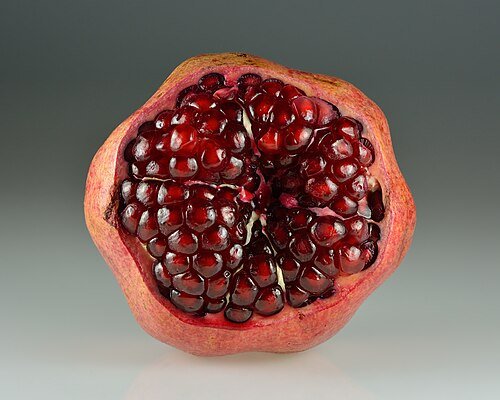
Punica granatum is one of the oldest cultivated fruits in the world, grown from the Mediterranean to South Asia for at least five thousand years, and for most of that time its rinds went somewhere useful. Not into the trash. The thick, leathery outer skin of the pomegranate, the part that makes up roughly half the weight of the fruit and the part that today's juice-focused pomegranate economy discards entirely, is one of the most versatile materials in natural dyeing.
This is the pleasant kind of discovery in the dye world: that the byproduct, the thing you were about to compost, turns out to be the part that matters.
Three Things at Once
Pomegranate rinds contain ellagitannins, a class of tannin compounds, at very high concentrations. Tannins do several things in a dye context:
They bond to cellulose fibers (cotton, linen, hemp) in a way that most natural dye compounds don't, providing anchoring sites for dye molecules that otherwise can't bond to plant-based fibers. This is the standard pre-mordant process: tanners know this, natural dyers know this, and pomegranate rinds are one of the most effective tannin sources for this purpose.
They also contain chromogenic compounds, colorants that produce yellow-green tones independently of any other dye. The color from pomegranate rinds alone, without added mordants, lands in the yellow to warm green range on most fibers.
And because tannins chelate metal ions, pomegranate rinds also act as a partial mordant in their own right, fixing some of the same metal mordants that a separate alum or iron bath would provide.
So the rind processes the fiber, colors the fiber, and helps fix the color, all from a single material. For cotton and linen in particular, which notoriously resist natural dyes without careful preparation, pomegranate rind pre-treatment dramatically improves results.
Modernhaus follows the thread from raw fiber to finished fabric.
Explore the Textile Studio →The Colors
On alum-mordanted wool, pomegranate rinds produce a warm yellow to yellow-green that's clean and pleasant if not as saturated as some other yellows. The color has a slightly different quality from onion skin gold or goldenrod yellow: a little more green, a little more muted, sitting in that yellow-olive space that reads well in combination with other colors.
Iron mordant or afterbath shifts the color dramatically into olive and gray-green territory, which can be exactly what you want if you're building an earthy, botanical palette. The iron-pomegranate combination on wool produces a deep, warm khaki-olive that looks like it belongs in a landscape.
Copper saddens and greens the color similarly but more warmly than iron. On cotton pre-treated with the rinds and then dyed with other colorants, the pomegranate treatment enriches the final color considerably, adding warmth and depth to what would otherwise be a flat result.
On silk the color is brighter and more saturated than on wool, which is typical for protein fibers; the yellow is cleaner and the green shift with iron is particularly striking.
The Carpet Connection
Pomegranate rinds have a specific and important place in Turkish and Persian carpet dyeing traditions. The natural dye palette for Anatolian and Central Asian carpets is among the most sophisticated in the world, combining madder reds with indigo blues and a range of yellows and tans from local plant sources, and pomegranate was one of those local sources.
In Anatolia, where pomegranates grow easily and were a significant agricultural crop, the rinds from the fruit industry became a dye material at no additional cost. The yellow-greens and the tannin fixation properties made pomegranate a foundational ingredient in the preparation of wool for carpet dyeing, particularly for the cotton and wool foundation fibers that needed the extra bonding help.
This is also the tradition that produced some of the earliest systematically documented natural dye techniques. Analysis of antique Turkish and Persian carpets has revealed the dye sources used in the 16th and 17th centuries, and pomegranate appears consistently in the background of the chemistry alongside the showier reds and blues.
Practical Notes
Dried pomegranate rinds are available from specialty natural dye suppliers, from Middle Eastern grocery stores (where they're sold as a spice and souring agent in some cuisines), and from your own kitchen if you eat pomegranates. The rinds peel off easily when the fruit is fresh, and they dry completely in a few days spread on a rack. They keep indefinitely dry.
For the dye bath, simmer the rinds in water for an hour, strain, and add your mordanted fiber. The color strikes readily and the bath exhausts slowly; a second and even third batch of fiber will pull usable color from the same rinds. Lightfastness is moderate to good depending on the fiber and mordant, better than fugitive dyes like turmeric but not in the exceptional class.
The tannin pre-treatment function is arguably the most valuable thing pomegranate rinds offer. If you work with cotton or linen and find natural dyes disappointing on those fibers, try a pomegranate rind bath before your dye bath. The improvement is often dramatic enough that what was a frustrating process becomes a reliable one.
The pomegranate itself has accumulated thousands of years of symbolic weight: fertility, prosperity, the underworld, the seasons. Persephoneia ate six seeds and had to return to Hades for six months of every year. The rind, meanwhile, was quietly doing the practical work of making everyone's cloth hold color. Both aspects of the fruit have a kind of staying power.