Madder Dye: The Root That Coloured the Ancient World Red
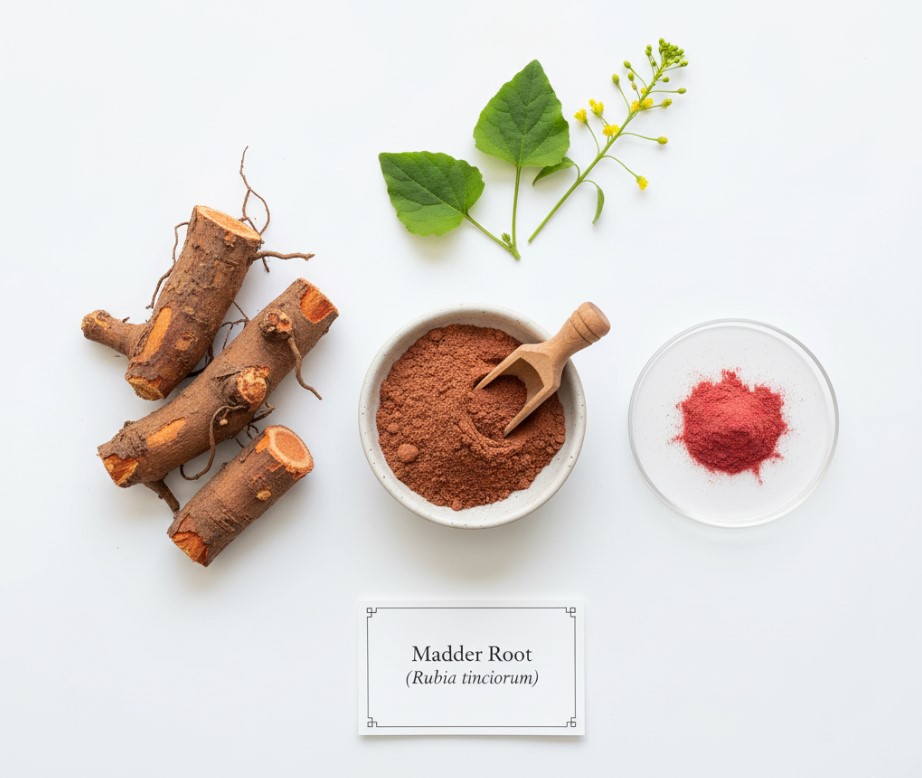
In 1868, natural madder supplied roughly half the world with red.
In 1869, two German chemists named Graebe and Liebermann published a paper synthesising alizarin, the active compound in madder root, from coal tar. Commercial synthetic alizarin was in production by 1871. Within a decade, the European madder industry, which had been growing and processing Rubia tinctorum for centuries, had effectively ceased to exist.
The speed of the collapse was remarkable. Whole agricultural regions in France, the Netherlands, and the Levant had been organized around madder cultivation. The town of Avignon had built its textile economy on it. The farms were still there, the infrastructure still there, the expertise still there. The chemistry had simply overtaken them.
Synthetic alizarin was cheaper to produce, more consistent in quality, and required no agricultural land, no harvest, no fermentation. You can argue that it represented progress. You can also note that it wiped out an agricultural tradition that had functioned continuously since before the written record begins.
What Madder Is
Rubia tinctorum, dyer's madder, is a trailing perennial plant in the family Rubiaceae, native to the Middle East and Central Asia. The dye comes from the roots, which must be at least three years old before they contain sufficient colorant to be worth harvesting. The roots are dried and ground; the resulting powder, or the extract prepared from it, is the dyestuff.
The primary active compound is alizarin (1,2-dihydroxyanthraquinone), along with related compounds including purpurin and munjistin. These compounds require a metal mordant to bond to fibre. With different mordants, madder produces different colours on the same cloth:
With alum mordant: brick red to coral. With iron mordant: purple-brown to burgundy. With copper: rust orange. With tin: bright scarlet.
The range of colours achievable from a single dyeplant through mordant variation is part of what made madder so valuable. You could produce red, burgundy, orange, and scarlet from the same root stock, depending on what metal you used as a fixative. This is the mordant colour-modification principle described in the mordants post, and madder is among the clearest examples of it in practice.
Modernhaus follows the thread from raw fiber to finished fabric.
Explore the Textile Studio →The Ancient Record
The oldest surviving madder-dyed textiles are fragments found in the tomb of Tutankhamun, dating to around 1325 BCE. Madder residue has been identified in textile fragments from the Indus Valley civilisation. The dye is documented in ancient Greek and Roman sources, where it was used for wool, silk, and leather.
What this means is that the same dyeplant was in continuous use from before the Egyptian New Kingdom to the nineteenth century: roughly 3,000 years of documented use. Very few agricultural products have that kind of continuity.
The knowledge of how to achieve the deepest, most permanent reds with madder was also one of the more closely guarded trade secrets in textile history.
Turkey Red
The most coveted madder-based colour was a process called Turkey Red: a deep, brilliant scarlet on cotton that was extraordinarily lightfast and washfast. The process achieved colours on cotton that most natural dyes could only achieve on wool or silk.
The Turkey Red process was genuinely complex. Contemporary descriptions mention multiple steps involving sumac and oak galls, calf's blood, sheep's dung, oil, soda, alum, and a tin solution, all applied in specific sequences over multiple days. The full process could take weeks. The resulting colour was a deep, slightly warm red that remained vibrant after years of washing.
The technique originated in the Ottoman Empire and the Levant, where it had been practised for centuries. European textile manufacturers wanted it desperately. Greek and Armenian craftspeople who knew the process were eventually persuaded to travel to France in 1746 and 1747, where they established Turkey Red production in Rouen and later in Mulhouse. The process reached Manchester in the 1780s, where it was adapted for the industrial scale of the British cotton mills.
The red coats of the British Army were dyed with madder. Earlier examples, particularly officers' coats, used cochineal (from scale insects on Mexican cacti), which produced a brighter scarlet but cost considerably more. Madder provided the consistent, durable, affordable red that equipped infantry at scale.
The Ottoman Carpet Connection
The carpets of the Ottoman Empire, and the broader tradition of pile weaving across Anatolia, Persia, and Central Asia, depended heavily on madder. The reds and burgundies in antique Turkish and Persian carpets are predominantly madder-based, often achieved through the Turkey Red process on wool rather than cotton.
The specific quality of madder red in these textiles, particularly after decades or centuries of use, is distinctive. The colour shifts and mellows rather than fading uniformly: the reds move toward coral or brick, the burgundies lighten unevenly. Antique carpet dealers sometimes describe this quality as "abrash," the variation in colour across a carpet's surface, which in old examples often reflects natural variation in the dye lot, the age of the roots used, and the specific mordant concentrations in different batches.
What Synthetic Alizarin Did
Graebe and Liebermann's 1869 paper described a pathway from anthracene (a component of coal tar) to alizarin. The synthesis was almost immediately industrialised by BASF and by the British firm Perkin and Sons: William Perkin, who had accidentally synthesised the first synthetic dye (mauveine, a purple) in 1856, now turned his laboratory to alizarin.
Synthetic alizarin was available commercially in 1871. It was chemically identical to natural alizarin. It produced the same colours with the same mordants. It was cheaper, consistent, and available in unlimited quantity.
The madder farmers of Provence, the Netherlands, and the Levant had no equivalent advantage to offer. Their product cost more to produce. It varied in quality with harvest conditions and root age. It couldn't scale infinitely. By the 1880s, natural madder cultivation had collapsed across most of Europe.
The knowledge of Turkey Red survived for somewhat longer, transferred to synthetic alizarin as the dye base. The process of mordanting, dyeing, and developing Turkey Red on cotton could be done with synthetic alizarin just as well as with natural madder. What was lost was not the colour but the cultivation tradition and the specific character that natural madder gave to the finished textile.
Madder and Natural Dyeing Now
Madder root is available from natural dye suppliers today, often grown organically in the Netherlands, Turkey, or India, the same regions where cultivation has the longest history. The dyeing properties are the same they have always been: reliable reds and burgundies with alum mordant, the colours shifting toward warmer or cooler depending on the specific root source and the pH of the dye bath.
Madder is among the most lightfast of all natural dye plants, particularly on protein fibres with alum mordant. Properly madder-dyed wool will retain its colour for decades under normal use. The antique carpets are the best evidence: examples from the sixteenth and seventeenth centuries, when madder was the primary red dye, retain colour that is recognisably red after four hundred years.
The 3,000-year continuity ended in a decade. The chemistry that ended it was, by the logic of materials science, an improvement: more consistent, cheaper, scalable. What it couldn't replicate was the particular character of a colour that had been grown in the ground for three years, harvested, dried, and used to dye cloth in the same way it had been used since before Tutankhamun's tomb was sealed.
That character is visible in old carpets. It's what collectors are paying for when they pay premiums for pre-synthetic pieces. The colour remembers where it came from.