Japanese Indigo: The Fermentation Vat That Takes Months to Build
The Yoshino River runs through Tokushima Prefecture on the island of Shikoku, and the climate there, warm and humid with rich alluvial soil, has been growing Persicaria tinctoria for over a thousand years. The plant is called "tade ai" in Japanese, and it is not the same species as the Indian indigo that dyed most of the world blue. It contains the same end molecule, indigotin, but it gets there differently, grows differently, and produces a color that experienced dyers say you can recognize by eye.
What makes Tokushima extraordinary isn't the plant. It's what happens to it after harvest.
Sukumo: The Living Dye
After the tade ai is harvested in late summer, the leaves are dried and then stacked in a special building, a sukumo gura, and composted. Not casually composted, the way you might pile garden waste; this is a managed fermentation, turned and watered and monitored over roughly one hundred days. The bacteria in the pile convert the indigotin precursors in the leaves into concentrated indigo. What comes out after three months is sukumo: a dark, earthy, slightly sweet-smelling mass that looks like compost and behaves like alchemy.
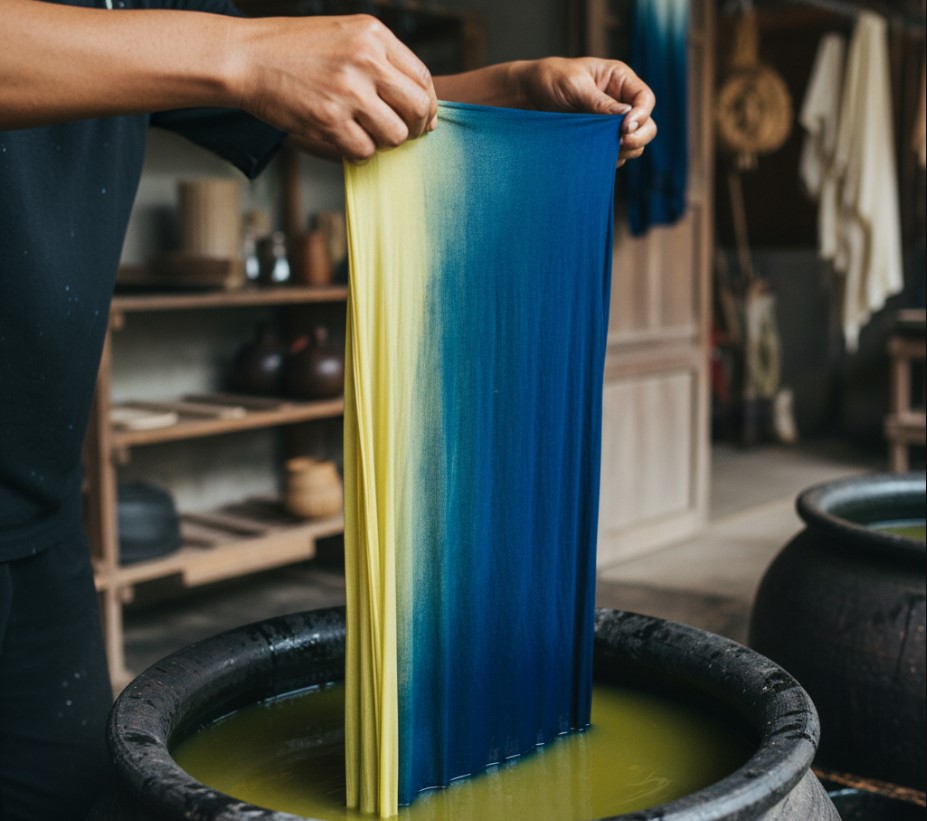
A sukumo vat is built from this material. The dyer adds alkaline wood ash lye, wheat bran as food for the bacteria, sake to encourage the right microbial environment, and shell lime to adjust pH. Then they wait, adjust, feed, and wait again. A healthy vat has a particular smell and a particular color, a greenish-blue foam called "indigo flower" on the surface that indicates active reduction. An unhealthy vat smells wrong, looks wrong, and gives pale or uneven color.
The chemistry is the same as all indigo vat dyeing: you're reducing the insoluble indigotin to soluble leuco-indigo, dyeing in that reduced state, and oxidizing back to blue in the air. But sukumo vat chemistry is more complex, more variable, and more responsive to conditions than a simple chemical vat using sodium hydrosulfite and soda ash. It rewards attention.
Modernhaus follows the thread from raw fiber to finished fabric.
Explore the Textile Studio →The Awa Ai Tradition
The Awa region of Tokushima, named after the old province, was the center of Japanese indigo production from the Edo period onward. At its peak in the nineteenth century, the Yoshino River basin supplied indigo to textile producers across Japan: to the shibori workshops of Arimatsu, to the cotton weavers of Osaka, to the silk dyers of Kyoto. The merchants who controlled the trade, the "ai tonya," became enormously wealthy.
The Meiji industrialization and then the arrival of synthetic indigo after 1897 destroyed the industry. By the early twentieth century, synthetic dye had undercut every economic argument for growing and processing tade ai. The sukumo gura emptied out. The knowledge of how to manage a long fermentation vat began to disappear.
What survived, barely, was kept alive by a small number of families who continued the practice as craft rather than commerce. In the postwar decades, and accelerating from the 1970s onward, a revival began. Artisan dyers, traditional textile workshops, and eventually a government-designated preservation effort recognized that sukumo production was a form of intangible cultural heritage worth protecting.
What Japanese Indigo Looks Like
The color that comes from a sukumo vat has qualities that synthetic indigo doesn't quite replicate. It tends toward a warmer, more complex blue: not flat, not uniform, but varied in the way that any natural process varies. Multiple dips build depth differently than synthetic vats do. The color on silk has a particular luminosity.
The Japanese have dozens of named shades of indigo blue, from "hanada" (a pale, almost sky blue) through "hanaikada" (deeper, the color of a raft of flower petals on water) to "kon" (deep navy) and "kachiiro" (the darkest, almost black-blue, the color that samurai wore because it didn't show blood). This vocabulary reflects centuries of careful observation of what the vat produces under different conditions.
The connection to shibori is deep and practical. The resist-dyeing techniques that shibori encompasses, binding, stitching, clamping, and folding, were developed in part to work with indigo chemistry, creating patterns from the interplay of dyed and undyed areas. The Arimatsu shibori tradition, still active near Nagoya, uses both synthetic and natural indigo, but workshops that specialize in the traditional craft tend to work with sukumo when they want the depth that synthetic cannot give.
Growing It Yourself
Tade ai grows readily as an annual in most temperate climates. It's a vigorous plant, related to buckwheat and sorrel, and will produce enough leaves in a single season for small-scale fresh-leaf dyeing. Fresh-leaf dyeing is not the same as sukumo, which requires the long fermentation, but it produces a genuine blue on protein fibers like silk and wool, using the green leaves directly, pressed or blended and applied to wet fabric.
The result is lighter, more variable, and less permanent than vat indigo. But there's something direct and slightly startling about pressing a green leaf onto wet silk and watching blue appear, connecting a kitchen garden and a thousand years of craft in a single afternoon.