Turmeric Dye: The Yellow That Fades and Everyone Uses Anyway
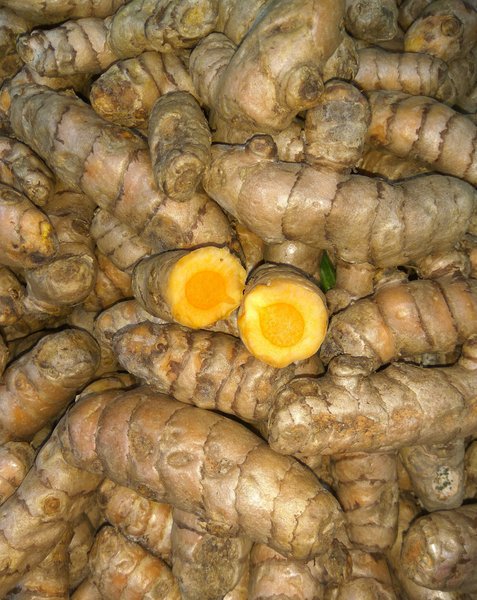
Turmeric is what dyers call fugitive: it fades. In sunlight it shifts from brilliant saffron yellow toward a pale, tired ochre. Ancient Indian textile manuals knew this. Medieval dyers knew it. The natural dye revival of the past few decades has rediscovered it, documented it carefully, and then largely kept using turmeric anyway, because the yellow it produces in its fresh state is extraordinary, and because its cultural presence across two and a half thousand years of human history makes it worth understanding.
The Buddhist monks' robes are the most visible example. That warm saffron-orange color, the color of monastic robes from Thailand to Sri Lanka to Japan, is not always turmeric: jackfruit bark, safflower, and other plant dyes are used depending on the tradition and the region. But turmeric has been part of the monastic palette for a very long time, valued not just for its color but for its associations: purity, renunciation, the sun.
What Turmeric Is
Curcuma longa is a rhizome in the ginger family, native to Southeast Asia and cultivated across South and Southeast Asia for at least four thousand years. The intense yellow of the fresh root comes from curcumin and related curcuminoids, compounds that also give turmeric its documented anti-inflammatory properties and its role as the active ingredient in the current wave of health supplement marketing.
As a dye, curcumin is substantive: it bonds to protein fibers like wool and silk without a mordant, which makes it extraordinarily easy to use. Simmer fiber in a solution of turmeric and water and the color strikes quickly and deeply. The result is a warm, bright yellow with an orange undertone, more saturated than onion skin dye and with a distinctly different character.
With different mordants the color shifts modestly. Alum produces the clearest, brightest version. Iron saddens it toward khaki. Copper deepens it slightly. The mordant effects are less dramatic than with some other dyes because the curcumin's bonding is primarily driven by its own chemistry rather than by the mordant bridge.
Modernhaus follows the thread from raw fiber to finished fabric.
Explore the Textile Studio →The Lightfastness Problem
Curcumin's molecular structure is the reason for its poor lightfastness. It contains a conjugated system of double bonds that absorbs visible light efficiently, which is why it's brilliantly colored, but those same bonds are vulnerable to photodegradation: UV light breaks them. The color changes are not uniform fading but a chemical transformation, which is why turmeric-dyed fabric doesn't just get paler but shifts to a different, dirtier yellow.
Dyers in medieval and early modern India were aware of this. The standard classification of dyes divided them into permanent and impermanent categories, and turmeric was consistently placed in the impermanent group, fine for ceremonial or temporary use, problematic for anything that needed to last. It remained in use because it was cheap, abundant, and the color in its fresh state was too good to ignore.
The Spiritual Color
The cultural weight of turmeric yellow extends well beyond fabric. In Hindu traditions, turmeric paste is applied to the skin at weddings and festivals; the color is auspicious, connected to Vishnu and to prosperity. In many South and Southeast Asian cuisines it's used as a food colorant as much as a flavoring. The saffron of Hindu religious practice and the saffron of Buddhist monasticism overlap in color even when they don't overlap in plant source, because both traditions converged on a particular warm yellow-orange as meaningful.
This is different from the economics-driven yellow of weld, which was used in medieval Europe primarily because it was the most lightfast yellow available and worked well with woad to produce greens. Turmeric's persistence in South Asian textile traditions has always been partly about meaning rather than purely about performance.
Turmeric in the Natural Dye Studio
For fiber artists working with natural dyes, turmeric occupies a particular niche. It's the fastest, easiest, most immediately rewarding natural dye: a first session that produces a genuinely beautiful color quickly and cheaply. The fugitive quality is real but manageable if the work isn't intended for permanent outdoor use.
The color also has interesting relationships with other dyes. Overdyeing turmeric yellow with indigo produces greens, and because turmeric fades while indigo doesn't, the color shifts over time from yellow-green toward blue-green. This is either a flaw or an interesting feature, depending on how you think about it: some textile artists deliberately use fugitive yellows in combination with stable blues to create color transitions that change with age.
The other advantage is availability. Grocery store ground turmeric works for dyeing. You don't need specialist suppliers or advance ordering. You need a pot, some fiber, some water, and the jar in your spice cabinet. That immediacy, that directness, connects every person who has ever cooked with turmeric to a tradition of coloring cloth that goes back to a time before writing was widespread.
The yellow fades. The tradition doesn't.