Nalbinding: The Ancient Textile Technique That Predates Knitting by Thousands of Years
Somewhere in Egypt between 300 and 500 CE, someone made a pair of toe socks. They used a technique that involves a single blunt needle and short lengths of yarn joined by a specific knotted stitch. The socks are split at the toe to accommodate sandals, which is a detail that makes them feel both ancient and completely logical. They are in a museum in Copenhagen. They are the oldest surviving examples of nalbinding, and they are better preserved than you'd expect something textile and fifteen hundred years old to be.
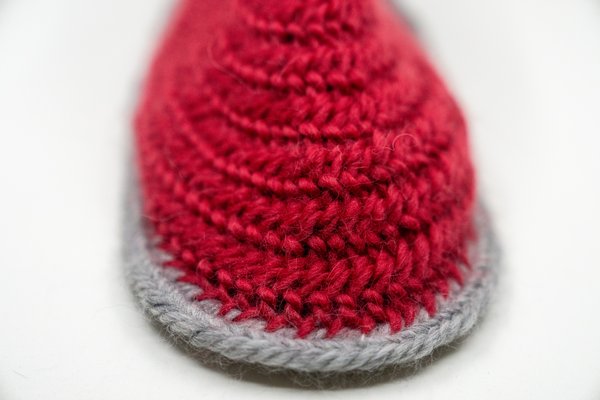
This is part of what makes nalbinding interesting: the fabric it produces doesn't unravel. Modern knitting has two parallel strands running through every stitch. Pull the yarn and the stitches cascade undone. Nalbinding stitches lock through each other in a figure-eight structure that, once made, is essentially permanent. You cannot "frog" a nalbinded piece. The fabric behaves more like felt than like knitting, thick and dense and forgiving.
What Nalbinding Actually Is
The word comes from Norwegian: "nål" means needle, "binding" means, well, binding. You work with a blunt needle, something like a large tapestry needle, threaded with a short length of yarn, maybe thirty centimeters. When you run out of yarn, you join a new length with a specific knot, spliced into the old end so the join is nearly invisible and structurally sound.
The stitch itself passes through previous loops in a figure-eight pattern. Different regional traditions developed different stitch structures: the Oslo stitch, the York stitch, the Finnish stitch, the Coptic stitch. Each produces a slightly different fabric texture, a slightly different elasticity, a slightly different set of properties. Experts can identify the tradition by examining the stitch structure of a fragment.
The technique is slower than knitting. It requires working with short lengths of yarn. It cannot be done with the continuous yarn ball that modern machine spinning produces so easily. These limitations are real, and they explain why nalbinding largely disappeared from European textile practice by the medieval period, when knitting, which is faster and more flexible, spread widely. What nalbinding offers in return is a fabric so structurally integrated that it can survive fifteen centuries in Egyptian sand.
Modernhaus follows the thread from raw fiber to finished fabric.
Explore the Textile Studio →Where It Appears in the Historical Record
The geographic and temporal spread of nalbinding is remarkable. Egyptian Coptic examples from the 4th to 7th centuries CE. Viking Age finds from Norway, Sweden, Denmark, and Dublin — including a nalbinded mitten found in Åsle, Norway that has been dated to around 700 CE. Medieval examples from across Scandinavia. Finds from Peru, from Israel, from Russia.
The Israeli connection is particularly interesting: a specific form of nalbinding was used to make the tassels (tzitzit) required on Jewish prayer garments, and this use continued in some communities well into the modern period. The technique was maintained as a religious requirement where it had largely vanished as a textile practice elsewhere.
In the Nordic countries, nalbinding survived in folk practice long enough to be documented by textile historians in the nineteenth and early twentieth centuries. Norway in particular has a continuous living tradition, and the technique has been taught in folk high schools and craft organizations. The connection to Scandinavian textile history runs deep: the same cultures that produced the great weaving and embroidery traditions also maintained this older looping technique.
The Modern Revival
The global nalbinding revival began in earnest in the 1980s and 1990s, driven largely by historical reenactment communities — Viking Age and medieval reenactors who wanted to make accurate textiles. Researchers worked backward from surviving objects to reconstruct the stitch structures, and instructors began teaching at events and through workshops.
The internet accelerated it considerably. Video tutorials for techniques that are almost impossible to describe in text became available, and the community of nalbinders who had previously worked in geographic isolation could compare notes, identify regional stitch variants, and teach each other. It's now a genuinely active craft with a global community.
What draws people to it, beyond the historical depth, is something similar to what draws people to natural dyeing or to hand spinning: the directness of the process, the connection to materials, and the quality of the result. Nalbinded wool fabric is extraordinarily warm and durable. It compresses rather than pilling. Wool socks made with it conform to the foot in a way that knitted socks don't quite match.
The toe socks in Copenhagen are worn. You can see where the feet were, where the fabric compressed and adapted over years of use. That's the test of a textile technique: whether the objects it makes actually serve the people who use them. These socks passed.