Natural Blue Dye: Why Blue Was the Hardest Color to Get onto Fabric
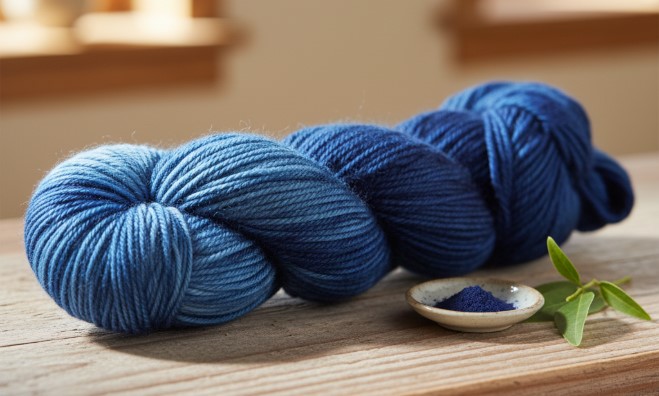
Blue is everywhere. The sky is blue. The sea is blue. Certain irises and cornflowers and larkspur are deeply, stubbornly blue. And yet for most of human history, getting blue onto fabric and making it stay there was one of the hardest problems in the textile trade.
The reason is chemistry. Most of the blue pigments that exist in nature don't transfer to fiber. The blue in a blueberry runs and fades. The blue in a morning glory doesn't bind to cloth at all. Lapis lazuli, the brilliant blue stone ground into pigment for painting, is useless for dyeing. The color that made medieval painters weep with joy would barely tint a wet rag.
The plants that actually work, the ones that contain molecules that bond to fiber and hold their color, are a small and strange group. And getting the color out of them requires chemistry that the ancient world stumbled into empirically, without understanding why it worked.
Woad and the Blue of Europe
For most of European history, woad was the only source of blue. Isatis tinctoria, a plant in the mustard family, native to the steppes of Central Asia and long cultivated across Europe, contains a small amount of the molecule indigotin, the same molecule that makes indigo blue. The amount is small, which is why woad dyeing is laborious and the results rarely as deep as true indigo, but for several thousand years it was what European dyers had.
The woad trade built Toulouse and enriched the merchants of Erfurt and Magdeburg. Blue cloth was expensive because it was difficult to produce. The process required fermenting the woad leaves into a paste, then fermenting the paste further in a vat with urine and bran and ash, creating the alkaline, oxygen-depleted environment that converts indigotin into its soluble form, leuco-indigo, which penetrates fiber and then oxidizes back to blue when lifted into the air.
That blue moment, when a yellow-green cloth comes out of a woad vat and turns blue in front of your eyes as it oxidizes, is one of the most satisfying things in the natural dye world. Medieval dyers saw it happen every day and didn't understand the chemistry at all. They just knew it worked.
Modernhaus follows the thread from raw fiber to finished fabric.
Explore the Textile Studio →Indigo and the Revolution in Blue
When Indian indigo arrived in Europe in quantity in the late sixteenth century, it was a different order of magnitude. Indigofera tinctoria contains far more indigotin than woad: a pound of indigo cake produces as much blue as perhaps fifty pounds of woad. The color was deeper, more consistent, and cheaper per yard of cloth dyed.
The woad interests fought back. In France, the penalty for using Indian indigo was, at various points, death or confiscation of goods. Henry IV banned it in 1609 under penalty of death. The same protectionist legislation appeared across Germany and England. The arguments given were economic: the woad farmers needed protection. The underlying truth was that Indian indigo was simply better and everyone knew it.
By 1700, indigo had won. The Tolfa alum mines that had funded the papal wars were a memory; the woad towns of Languedoc were declining; and indigo from India and then from South Carolina and the Caribbean was being shipped in hundredweight bales across the Atlantic trade routes.
The Chemistry of Blue
What makes blue so different from other dye colors is the mechanism by which indigotin bonds to fiber. Most natural dyes are water-soluble and bind to fiber through mordants, metal salts that bridge dye molecule and fiber molecule. Indigotin is not water-soluble. You can't dissolve it and dip cloth into it. Instead, you have to chemically reduce it: strip away the oxygen that makes it insoluble and inert, convert it into leuco-indigo, which is yellow-green and water-soluble and will penetrate fiber, and then let it oxidize back to its insoluble blue form once it's inside the fiber.
This is why indigo dyers talk about "feeding" their vats. A vat that isn't maintained, that has too much oxygen or the wrong pH or insufficient reducing agent, stops working. The dye falls out of solution. You get mottled, uneven color or nothing at all. It's a living system, and treating it as such — checking it, adjusting it, understanding its moods — is as much craft as chemistry.
From Plant to Synthetic
In 1865, the German chemist Adolf von Baeyer began working on the structure of indigotin. He established the full molecular structure in 1883 and was awarded the Nobel Prize for Chemistry in 1905, partly for this work. BASF and Hoechst raced to synthesize it commercially. Synthetic indigo reached the market in 1897.
The natural indigo industry, which had been the economic foundation of whole regions of India and the American South, collapsed within a decade. The colonial economics of natural dye had driven extraordinary exploitation, indigo in particular: the forced cultivation of indigo on tenant farmers in Bengal was a major grievance that contributed to the 1857 uprising and later to Gandhi's first major satyagraha in Champaran in 1917.
Synthetic indigo now dyes almost all the blue denim in the world. It's also what makes blue jeans fade: the same surface-bonding quality that makes indigo's wash-off into a vivid streaky fade is characteristic of how indigotin bonds to cotton, sitting on the surface of the fiber more than penetrating deep into it.
For natural dyers, the plants are still there. Japanese indigo grows readily in temperate gardens. Woad grows almost anywhere in Europe. The chemistry hasn't changed. The blue that comes out of a well-maintained fermentation vat, however you get there, is a color that synthetic production still struggles to exactly match: complex, warm, slightly varied from yard to yard, alive in a way that uniform synthetic cannot quite be.