Oak Gall Ink: The Ancient Recipe That's Still Eating the Documents It Wrote
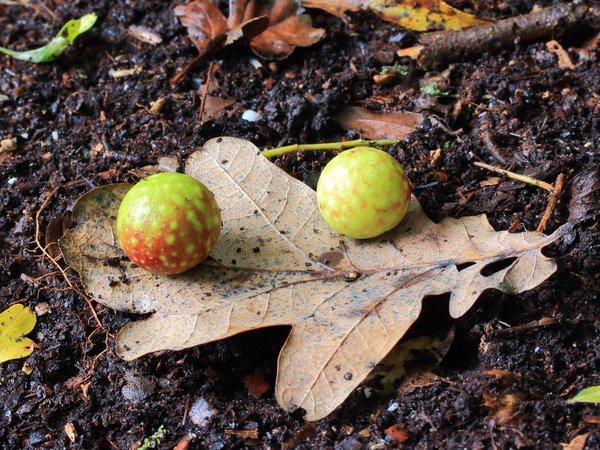
There is a small wasp, Cynips quercusfolii, that lays its eggs in oak buds. The tree responds to the larva's presence by growing a sphere of dense, tannin-rich tissue around it, a protective gall about the size of a marble. The larva feeds on this tissue, develops through winter, and emerges in spring, leaving behind an empty brown sphere full of some of the most chemically reactive material in the plant world.
For roughly fourteen hundred years, humans collected these spheres, ground them into powder, and made ink.
Iron gall ink is what you get when you combine the tannic and gallic acids from oak galls with iron sulfate (ferrous sulfate, which was available in medieval Europe as green vitriol, a naturally occurring mineral). Add gum arabic to bind it and give it the right flow, dilute with water or wine, and you have a liquid that starts out pale gray on the page and darkens over hours and days to the deep black-brown that covers the pages of medieval manuscripts, Bach's autograph scores, the diaries of Darwin, and the notebooks of Leonardo.
Why It Worked So Well
The chemistry is elegant in a way that most early technologies aren't. When the iron-tannin complex hits the page and oxidizes, it forms a compound that bonds to the cellulose fibers of parchment or paper. It doesn't sit on top of the surface the way carbon black inks do; it becomes part of it. Which is why iron gall documents survive so well: the writing is in the material, not on it.
The color deepens as it ages, which was useful for documents that needed to look authoritative. A fresh document written in the pale initial gray would be harder to pass off as old than one that darkened naturally over decades. Forgers hated this. Archivists noticed it.
The technique spread from the Mediterranean world through Europe and remained the dominant ink formulation from roughly the 5th century through the 19th. The natural dye world developed in parallel with this ink tradition; the iron sulfate that mordants wool for deep, dark colors is the same iron sulfate that reacts with oak gall extract to make ink. Metalworkers, dyers, and scribes were all drawing on related chemistry without necessarily knowing it.
Modernhaus follows the thread from raw fiber to finished fabric.
Explore the Textile Studio →What It Wrote
When you list the documents written in iron gall ink, the list becomes almost absurd in its scope. The Magna Carta, 1215. The Book of Kells uses it in sections. The Dead Sea Scrolls include iron gall examples. Gutenberg's 42-line Bible was printed with an iron gall-based ink adapted for the press. The notebooks of Leonardo da Vinci, Michelangelo's drawings, Rembrandt's etchings, the autograph manuscripts of Bach, Handel, Mozart, and Beethoven all use iron gall.
The Declaration of Independence was written with an iron gall formulation on parchment, which is why the text has faded to something nearly illegible in places: the parchment darkened over time while the ink paradoxically lightened, reducing the contrast. It's kept in low light and controlled humidity now, fighting the slow chemistry still happening in the document.
The Problem It Creates
Here is the uncomfortable part: iron gall ink is corrosive. The same gallic and tannic acids that make the compound bond so effectively to cellulose also continue to acidify the substrate after the ink has dried. Over centuries, the acid migrates outward from the writing, weakening and eventually destroying the parchment or paper around it. Documents don't burn; they eat themselves from the letters outward.
Iron gall corrosion is one of the primary concerns in manuscript conservation worldwide. The inks on Beethoven's working manuscripts have eaten holes through the paper at heavily corrected passages, where he wrote and rewrote and crossed out. Some of his sketches are now held together as fragments; the lines he wrote most vigorously are the ones that destroyed the page.
Conservation approaches include calcium hydroxide treatment to neutralize the acid, careful humidity control to slow the reaction, and digitization to capture the text before the physical object deteriorates further. None of these reverse the damage already done.
Making It Now
Iron gall ink is still made by natural dye enthusiasts and calligraphers. The recipe is simple enough that it was copied by hand into household books for centuries: gather oak galls, crush them, steep in water or wine, strain, add ferrous sulfate, add gum arabic, adjust consistency.
The modern versions are typically less acidic than historical formulations because we understand the corrosion problem and can moderate the chemistry. Calligraphers use it because the depth and character of the color is unlike any synthetic ink. The slight roughness it gives to paper, the way it settles into the texture of a surface, produces a quality that people who care about writing instruments describe with the kind of vocabulary usually reserved for wine.
What the oak gall gave us was an ink so effective at bonding to surfaces that it has outlasted almost every civilization that used it. And it is, very slowly, still working, still reacting, still darkening and eating and transforming the records of things that happened a thousand years ago. The chemistry doesn't know it's done its job. It just keeps going.