The Eames House: Built from a Catalog, Lived In for Life
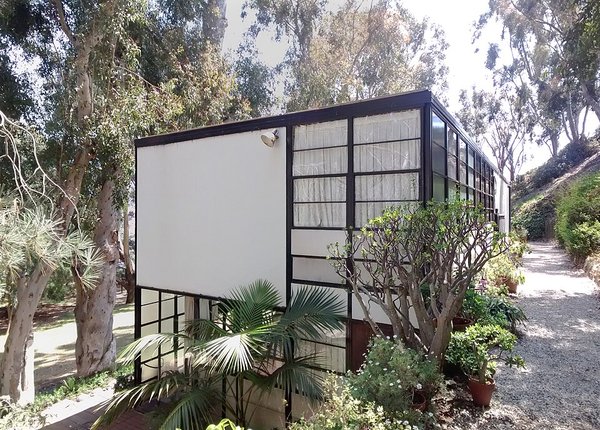
The steel frame sat completed on the Pacific Palisades site for several months in 1948, and during that time Charles and Ray Eames looked at it and decided it was wrong. The design was sound, the structure was up, but something about the proportion was off. They changed the plan. The same steel members were reconfigured into something different, something that achieved what the original design was trying for in a way the original design hadn't quite managed.
What they built — Case Study House #8, completed in 1949 — is one of the most influential houses of the twentieth century. Two rectangular volumes, one a studio and one a residence, connected by a breezeway, sitting in a meadow above the Pacific. The exterior panels are primary colors and gray and white in a grid of steel, which has made it look unmistakably like a Mondrian painting ever since the first photographs appeared. This may have been intentional. More likely it was a convergence of the same sensibility arriving at similar places through different means.
The Program
In 1945, the Los Angeles-based magazine Arts and Architecture launched the Case Study House Program, which asked prominent architects to design and build model homes for the postwar housing market. The idea was that America was about to need enormous amounts of new housing and that modern design should inform what got built. Thirty-six houses were eventually commissioned over two decades; about half were built.
The brief was democratic: these were to be homes for ordinary people, buildable at reasonable cost with available materials. Prefabrication, steel, and off-the-shelf industrial components were encouraged precisely because they were efficient and accessible. The architects involved, including Richard Neutra, Raphael Soriano, Craig Ellwood, and Pierre Koenig (whose Case Study House #22 is the most photographed house in California), were working within real constraints, and those constraints shaped the results.
Charles Eames designed his own house for the program with his partner John Entenza. Eero Saarinen was brought in as co-designer on the original scheme. When the redesign happened, it was Charles and Ray's vision that emerged.
Modernhaus documents mid-century modern design history in one place.
Explore the Design Archive →Catalog Architecture
The specific innovation of the Eames House was the commitment to using only what was available from industrial suppliers. The steel sections, the sash windows, the panels, all of it was ordered from catalogs used by factories and warehouses. Nothing was custom-fabricated. The house was, in a sense, a proof of concept: that with sufficient design intelligence, a genuinely beautiful and livable building could be assembled from the standard building blocks of industrial production.
The construction costs have been reported variously but landed around $9,000, or roughly $100,000-$120,000 in current dollars, which for a two-structure compound on a hilltop site with ocean views was and remains extraordinarily economical. Most of the budget went not to fabrication but to the skill of knowing what to do with the materials.
This connects directly to the furniture work Ray and Charles were doing simultaneously. The plywood and fiberglass chairs that were coming out of their Venice studio were built on the same principle: use industrial materials and industrial processes, and put the design intelligence into how those materials are organized rather than into making precious custom components. The house was the architecture version of the Eames chair.
The Life Inside
What makes the Eames House unusual among canonical modernist buildings is that its residents actually lived in it, happily, for decades. Many of the great houses of high modernism became battlegrounds between their owners and their architects, or were lived in briefly before being sold, or were never inhabited domestically at all. Charles and Ray moved into their house and stayed.
They filled it with things they collected and loved: folk art, kites, toys, found objects, plants, fabrics. Ray's deep engagement with color, pattern, and material showed in the interior in a way that photographs couldn't fully capture. The house was a working studio, a domestic space, and a laboratory for ideas all simultaneously, and the three functions coexisted because the architecture was flexible enough and light-filled enough to accommodate everything.
Charles died in the house in August 1978. Ray died there exactly ten years later, August 1988, the same date to the day. The house passed to the Eames Foundation and has been open for exterior visits and periodic interior tours since.
What It Proved
Case Study House #8 demonstrated something that modernist architecture had been arguing for decades but rarely proved in lived experience: that industrial materials and prefabricated components, organized with genuine intelligence and care, produce a living environment of warmth and beauty rather than cold efficiency.
The Mondrian grid on the facade is also, seen in context, a meadow wall, a thing that changes with the light and the seasons, that connects to the trees around it and the sky above it. The steel doesn't feel industrial inside the house; it feels structural and honest. The standard components feel standard in the way that a well-made simple meal feels right: nothing is unnecessary, nothing is missing.
Every design school in the country has images of this house on its walls. The house earned them by being right about something, and by being lived in long enough to prove it.