Eva Zeisel: The Potter Who Designed in Her Head in a Soviet Prison
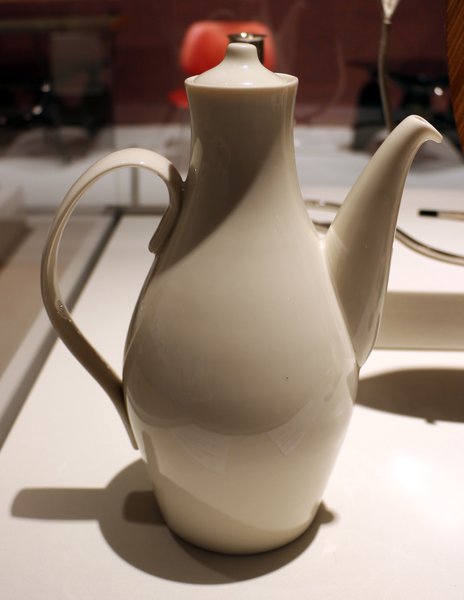
In 1936, Eva Zeisel was arrested in Moscow. She was thirty years old, a ceramics designer from Budapest who had gone to the Soviet Union because it seemed like the place where modernist design was actually being built into the fabric of society. The NKVD accused her of being part of a plot to assassinate Stalin. There was no plot. She was put in solitary confinement, interrogated, moved between prisons, and eventually held for sixteen months before being released and expelled from the country.
What she did in the cell, to keep her mind intact, was design pottery. She couldn't draw, couldn't make notes, couldn't work with clay. She designed in her head, turning forms in her imagination, thinking through shapes and relationships and how one vessel might connect to another. The biomorphic, organic quality that would define her work for the next seventy years came partly from that period: forms that referred to living things, to the way two creatures might nestle together, to the natural world as opposed to the industrial one she'd been working in.
Budapest to Moscow to America
Zeisel was born in Budapest in 1906 into an intellectual family — her mother was a sculptor, her grandmother helped found the Hungarian feminist movement. She studied at the Budapest Academy of Fine Arts and then began working in the Hungarian pottery guild system at nineteen, eventually becoming a master craftswoman. She moved through Hamburg and Berlin before the Soviet Union, drawn by the promise of designing for industrial production at scale, pottery for everyone rather than for the wealthy.
After her release and expulsion from the Soviet Union in 1937, she made her way through Vienna and London to New York in 1938, one year before the war. She arrived with nothing much and a very specific skill set, and she put it to work. By the early 1940s she was teaching at the Pratt Institute and at the New York State College of Ceramics.
Modernhaus documents mid-century modern design history in one place.
Explore the Design Archive →Town and Country
In 1943, Zeisel was commissioned by the American ceramics company Red Wing Pottery to design a line of tableware. The result was Town and Country, released in 1946, which remains one of the most recognizable ceramics designs of the mid-century. The forms are rounded and organic, the shaker and the cruet nestling against each other, the pitcher with its slight lean and its thumb rest that references a hand. The shapes feel like they grew rather than were designed.
The colors were deliberately simple — solid, matte, close to earth tones — which let the forms do the work. The modernist tradition Zeisel had trained in was largely functionalist, and Town and Country is functional, but the function is inhabited by something warmer than pure utility. The pieces have personalities. They seem like they enjoy being used.
The same year Town and Country was released, the Museum of Modern Art mounted an exhibition of Zeisel's work. It was the first one-woman show in MoMA's history. She was forty years old.
The Shape of a Career
What followed was sixty years of continuous practice. Zeisel designed for Rosenthal, for Hall China, for Castleton, for dozens of manufacturers across the United States and Europe. She came back into public consciousness in the 1980s when a new generation of designers and curators rediscovered her work, and in the 1990s her early pieces began to be reissued and collected seriously. She kept designing.
Her theoretical framework, developed over decades of teaching, rejected what she called the "functionalist fallacy" of high modernism — the idea that form follows function and that aesthetic pleasure is secondary. For Zeisel, the pleasure of holding a well-designed cup, the way it fit the hand, the way it caught light, was itself a function. Pottery exists in relationship with human bodies. A form that feels right to hold has succeeded in a way that a form that merely holds liquid has not.
She was still designing and still giving interviews into her late nineties. She died in 2011 at age 105, which gives her career a length that is almost impossible to comprehend: she began working before the Second World War and was still engaged with design questions after the iPhone existed. The biomorphic forms she worked out in a Soviet prison cell were still in her hands seven decades later.
The Town and Country pieces are in collections worldwide now. They look contemporary in a way that dated things don't, which is the sign of something that found a permanent truth rather than a temporary trend. Zeisel found it in her head, in a cell, at thirty, when finding anything at all must have required a kind of deliberate, determined attention to the world beyond the walls.