Eliel Saarinen: The Man Who Lost a Competition and Won America
In 1922, the Chicago Tribune ran one of the most famous architecture competitions in history, asking the world's architects to design "the most beautiful and distinctive office building in the world." Two hundred and sixty-three entries arrived from twenty-three countries. The winning design, by Raymond Hood and John Howells, was a Gothic tower in white limestone, and it was built, and it still stands on Michigan Avenue.
The second-place entry, by a Finnish architect named Gottlieb Eliel Saarinen, was not built. It was a setback tower, stepping back as it rose, with a vertical emphasis that was new and powerful and nothing like the Gothic historicism that had won. Louis Sullivan, the patriarch of American architecture, published a review in a trade journal saying that the Saarinen design was the superior work: that it understood where tall buildings needed to go, that it was thinking about the twentieth century while Hood's tower looked backward.
Sullivan's review made Eliel Saarinen famous in America overnight. He emigrated with his family in 1923. He never went back to Finland.
Helsinki and the National Romantic
Before Chicago, Saarinen had spent twenty years building one of the great bodies of early modern architecture in Europe. He was born in 1873 in Rantasalmi, Finland, studied architecture in Helsinki, and made his name with the Finnish Pavilion at the Paris Universal Exposition of 1900, a building that drew on Finnish folk traditions and medieval stonework while feeling entirely contemporary.
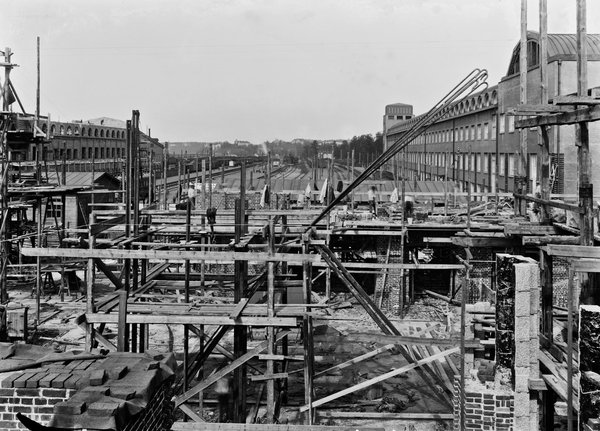
His Helsinki Central Station, completed in 1919, remains one of the defining buildings of his career and one of the great railway stations in the world: granite-faced, heavy, with four massive figures holding globe lanterns flanking the main entrance, and an interior that combines the monumental with the functional in a way that railway architecture rarely achieves.
What he was developing, across buildings like the station and the residential villas in Hvitträsk (which he designed with his partners and then lived in himself), was a synthesis of national tradition and modernist principle. It looked nothing like Viennese Secessionism or German Expressionism or any of the other European avant-gardes, but it was equally sophisticated. When the Tribune competition entry arrived in Chicago, American architects were seeing this thinking for the first time.
Modernhaus documents mid-century modern design history in one place.
Explore the Design Archive →Cranbrook: The School That Shaped Mid-Century America
In 1925, the Detroit industrialist George Booth was building a cultural campus outside the city in Bloomfield Hills, Michigan. He wanted a school of art, craft, and design. He commissioned Saarinen to design the buildings and lead the institution. The result was the Cranbrook Academy of Art, which opened formally in 1932.
Cranbrook under Eliel Saarinen became the most influential design school in America by mid-century, not through numbers but through the quality of its graduates. Harry Bertoia trained there. Ray Eames studied weaving there, and met Charles Eames there. Florence Knoll studied there. Eero Saarinen grew up there, the son of the director, surrounded by working artists.
Eliel's wife, Loja Saarinen, ran the weaving studio, building a textile program of the first order while her husband shaped the architecture curriculum. The campus buildings themselves were a constant teaching environment: Eliel designed everything from the structures to the furniture to the light fixtures, demonstrating in built form what integrated design meant.
The Father and the Son
Eero was born in 1910, the year his father began work on the Helsinki railway station. He grew up watching his father design, absorbing a professional culture that took craftsmanship and spatial thinking as absolute requirements. He won the competition for the Gateway Arch in St. Louis in 1948 and the TWA Terminal in New York in 1956, two of the great American buildings of the twentieth century.
The story is sometimes told as competition: the younger surpassing the older, Eero eclipsing Eliel. It's more complicated and more interesting than that. Eliel's influence on Eero was total and lasting, and Eero's success was built directly on the foundation Cranbrook provided. The Tribune competition that brought Eliel to America ultimately made Eero possible.
Eliel Saarinen died in 1950 at 77, having designed the campus where so much of mid-century American design was conceived, having trained the people who filled the furniture stores and corporate offices of postwar America with objects that still look right. He came in second once, and it was the best thing that ever happened to him.