Black Walnut Dye: The Brown That Never Lets Go
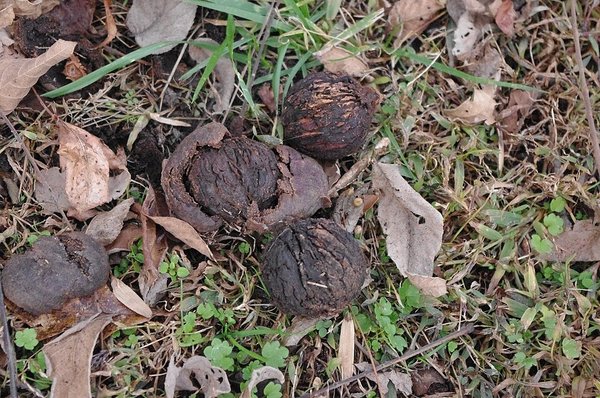
There is a moment in black walnut dyeing, usually sometime in late autumn when the green hulls have been sitting in water for a few days, when you lift the lid and find a liquid so dark it looks like you could write with it. It's almost black. The wood of the walnut tree has been used to make ink and stain for centuries, and the dye bath is not far off from that tradition: a deep, permanent brown that soaks into fiber with a completeness that more delicate natural dyes can only gesture toward.
The compound doing this is juglone, a naphthoquinone that the black walnut tree produces as a weapon. It's allelopathic: it leaches from the roots, the hulls, the leaves, and into the surrounding soil, suppressing the growth of competing plants. Tomatoes planted under a black walnut die. Horses that eat the hulls or stand on bedding made from walnut shavings develop a condition called laminitis, a painful inflammation of the hoof. The tree is defending its territory in chemical terms, and the collateral effect is one of the most permanent natural dyes we have.
The Dye Itself
Black walnut (Juglans nigra) hulls are the green outer layer of the nut, the part you'd peel off to get to the hard shell. They turn from green to black as they mature in autumn. Both work for dyeing, but the black, fallen hulls are easier to gather in quantity and produce a slightly deeper color.
The dye is substantive, meaning it bonds to fiber without a mordant. Wool, silk, cotton, linen: all of them take black walnut dye directly from a water bath. This is unusual. Most natural dyes need a mordant to bond to cellulose fibers like cotton and linen, but juglone is reactive enough to bond on its own. The color on all fiber types lands somewhere in the range of deep tobacco brown to walnut brown to, with enough dye material, something approaching dark chocolate.
Lightfastness is exceptional by natural dye standards. A properly dyed piece of wool in black walnut brown will hold its color through years of washing and reasonable light exposure in a way that fugitive dyes like turmeric simply won't. This made it valuable historically not just for textiles but for wood staining, leather tanning, and hair darkening.
Modernhaus follows the thread from raw fiber to finished fabric.
Explore the Textile Studio →One Thing to Know Before You Start
Juglone stains skin. Not like berry stains that wash off in a day or two; black walnut stains skin in a way that requires weeks to fade as the skin cells turn over naturally. This has a long folk history: walnut hull "tan" was used as a cosmetic darkener and as a way to fake a year-round tanned complexion in cold climates. It was used to darken hair. George Washington reportedly stained woodwork at Mount Vernon with a walnut hull preparation.
What this means practically is that you will want gloves when working with black walnut hulls. Not as a precaution; as a certainty. The dye in your dye pot will behave politely, but the raw hulls and the water they've been soaking in will mark you immediately and durably. Some dyers consider the stained hands a kind of seasonal badge, which is one way to look at it.
Gathering and Making the Dye Bath
Black walnut trees (native to eastern North America, planted widely as ornamentals and nut producers) drop their nuts in September and October. The hulls begin to blacken almost immediately on the ground. You can gather the fallen nuts, remove the hulls, and either use them fresh or dry them for later.
For the dye bath, cover the hulls with water and simmer for an hour or more. The water goes dark remarkably quickly. Strain out the hulls and you have a bath that will dye fiber directly: wet the fiber first, submerge in the dye bath, simmer gently, and the color strikes deep. The longer the fiber stays in the bath, the darker the result, but the color isn't delicate the way some natural dyes are; there's not much risk of over-dyeing.
Mordanting doesn't change the color dramatically the way it does with most dyes, because the juglone is bonding directly rather than through a mordant bridge. Iron afterbath can sadden the color slightly toward a cooler, grayer brown. Copper shifts it barely. The dye is doing its own thing.
Where the History Runs
Indigenous peoples of eastern North America used black walnut as a dye long before European contact, for fiber, for skin, and for wood. The Cherokee, Ojibwe, and many other nations documented its use in textile traditions. European settlers adopted the practice quickly because the dye was obviously effective and the trees were everywhere.
In the natural dyeing revival of the past few decades, black walnut has a secure place as one of the most approachable first dyes: easy to gather in season, impossible to fail with, producing colors that are genuinely beautiful rather than merely interesting. The warm brown family has an underappreciated richness in fiber; the black walnut range sits in it like a note that just belongs there.
The tree that produces it evolved its chemistry over millions of years to keep competitors away. That it also happens to produce one of the most useful and permanent dyes in the plant world is a reminder that the natural world's solutions to its own problems often turn out, quite accidentally, to be useful to ours.