Jean Prouvé: The Self-Taught Metalworker Who Built Houses Like Furniture
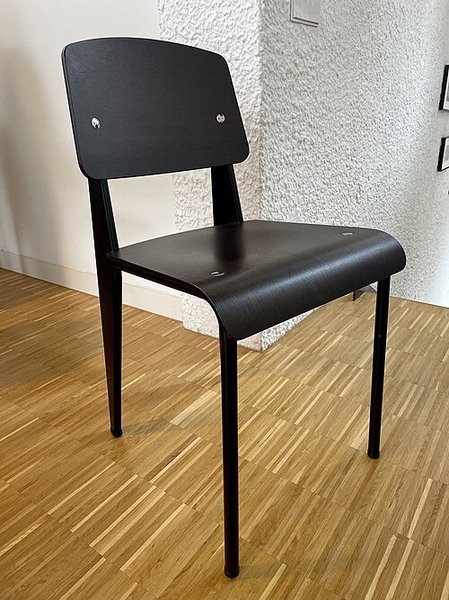
Jean Prouvé did not have an architecture degree. He trained as a metalworker, in Nancy, France, in the early 1920s, learning ironwork from the craftsmen of the Art Nouveau tradition and then moving into the new industrial metalwork that was changing what buildings and furniture could be. He opened his own workshop in Nancy in 1924. He was twenty-three years old, and he would spend the next six decades making things.
The things he made — chairs, tables, prefabricated houses, school buildings, façade panels, folding doors — all share a quality that is difficult to name precisely but immediately recognizable: they look like someone worked out the best way to do this particular thing with these particular materials and then did exactly that. No ornament. No historical reference. No design gestures toward style or period. Just the logic of the problem made visible.
The Standard Chair
In 1934 Prouvé designed the Standard Chair, a simple four-legged chair with a sheet metal back support and legs of unequal weight. The back legs are thin; the front legs are thicker and heavier, because the force on the front legs under a sitting person is greater than on the back. The difference in weight is the structural fact made visible: Prouvé read the forces in the chair and expressed them directly in the material.
This is the opposite of decorative design and the opposite of design that hides its structure. The Standard Chair looks the way it does because Prouvé believed that the logic of making a thing was also, if you got it right, the aesthetic of the thing. The chair was manufactured at his Nancy workshop and has been in continuous production, now by Vitra, ever since.
The Cité Chair from 1930 and the Antony Chair from 1950 operate on similar principles: the visible structure, the unequal leg weights, the combination of metal and wood or metal and upholstery that makes the material properties of each component explicit. You can look at a Prouvé chair and understand, without explanation, why it is the way it is.
Modernhaus documents mid-century modern design history in one place.
Explore the Design Archive →Prefabricated Houses and the Postwar Problem
After the Second World War, France faced an enormous housing shortage. Prouvé's response was to build houses with the same logic he brought to furniture: prefabricated panels, steel structure, components that could be transported in a truck and assembled on site without heavy equipment. He designed demountable houses for the French government in 1944-45, simple structures with a central ridge spine that carried all the loads, allowing the walls to be non-structural and therefore light and thin.
The logic was not about cheapness, though the houses were economical. It was about building as a manufacturing problem rather than a construction problem: designing the components so that the assembly required skill rather than equipment, and so that the building could be disassembled and moved if needed.
Several of these houses survive. One was reconstructed and exhibited at the Centre Pompidou in Paris. They look provisional and they look completely considered at the same time: you can see that someone thought very hard about how a wall panel meets a floor panel, how a window integrates into the structural system, how the ridge beam distributes forces to the footings. The thinking is in the joints.
The Workshop and the Exile
In 1952, Prouvé was forced out of his own company by investors who wanted to scale production and found his insistence on craft quality and structural integrity commercially inconvenient. He went back to being a consultant and independent designer. In 1953 he moved to Paris.
He had been elected to the Nancy city council in 1945, representing the French Resistance and the Communist Party, which made him a person of suspicion during the Cold War period. This did not directly cause his removal from the company, but it contributed to an atmosphere in which his position was precarious. He continued designing anyway.
The late career produced some of his most interesting buildings, including the Évian pump room (1956) and the Total petrol station prototype (1969), both of which show the same structural clarity and the same commitment to the logic of materials as the furniture from thirty years earlier. He was consistent in a way that is rare: the same person, the same values, the same approach, across six decades of work.
What Prouvé and Perriand Shared
Charlotte Perriand and Prouvé were contemporaries and, at various points, collaborators. Both were trained outside the academic architecture tradition — Perriand as a decorator, Prouvé as a metalworker — and both brought a maker's logic to design problems that the academic tradition approached differently. Both worked on the intersection of industrial production and individual design quality. Both are now recognized as among the most important French designers of the twentieth century, and both spent significant parts of their careers working outside the mainstream of French design culture.
The French design tradition of the mid-century period has a quality that distinguishes it from the Scandinavian tradition or the American tradition: a greater emphasis on the structural and the industrial, a willingness to leave material processes visible rather than finishing them away, and a commitment to logic over comfort. Prouvé is perhaps its purest expression. The Standard Chair is not comfortable in the way that an Eames lounge chair is comfortable. It is correct, and it lasts, and you can see why.