The Lucet: A Two-Pronged Tool That Makes Cord You Can't Buy Anywhere
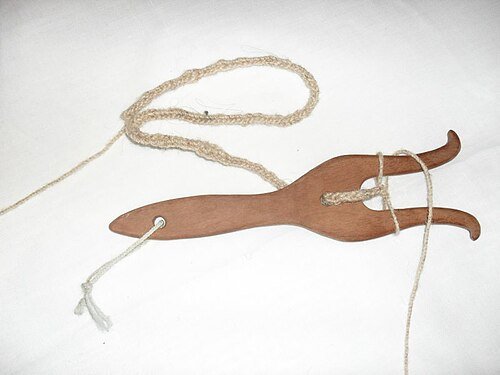
A lucet is a small thing, the size of a hairbrush, two prongs rising from a handle, with a hole through the middle. You thread yarn through the hole, loop it around the prongs in a figure-of-eight pattern, and work each loop over the other in a sequence that takes about five minutes to learn and about five hundred hours to get truly fast at.
What comes out is a square, firm, braided cord: four-sided in cross-section, with a consistent, tight structure that lies flat, holds its shape, and has a slight elasticity that round cord doesn't have. It was used for centuries as decorative trim on clothing, for lacing corsets and boots, for bell pulls in Victorian houses, for anything where a strong, decorative cord was needed. It cannot be made by machine in the same way, which is part of why it disappeared from everyday use and why it keeps getting rediscovered by people who want exactly the thing it makes.
How It Actually Works
The technique is entirely in the hands. The yarn threads up through the center hole of the lucet, which keeps the working supply taut and feeds smoothly. You loop the working yarn around both prongs in a figure-of-eight, so each prong holds one loop. Then you take the bottom loop on each prong and lift it over the top loop and off the prong, in alternation. Each time you do this, a new link is added to the cord growing out of the bottom of the lucet.
The cord is square because the figure-of-eight creates four structural faces, and the lifting action distributes tension evenly across all four. The center hole where the finished cord emerges keeps everything aligned as the cord grows.
You can add new yarn with a weaver's knot or a Russian join. You can work in multiple colors by changing yarn and creating striped or variegated cord. The tension is controlled entirely by how you hold the tool and how firmly you set each loop, which is where the skill lives: consistent tension produces smooth, even cord; variable tension produces cord that looks slightly lumpy and irregular.
Speed varies enormously. Experienced lucet workers can produce a meter of cord in twenty minutes. Beginners often manage a few centimeters in an hour while they're internalizing the sequence.
Modernhaus follows the thread from raw fiber to finished fabric.
Explore the Textile Studio →Where It Comes From
The lucet appears in European textile history from at least the eighteenth century, though the technique is likely older. It was used across England, Scandinavia, and continental Europe, and surviving examples from the 18th and 19th centuries are made from ivory, bone, wood, and tortoiseshell, decorated with varying degrees of elaboration. The more ornate examples were status objects in their own right.
The technique is related to, but distinct from, nalbinding and from finger-knitting. All three produce looped or braided structures with hand tools, but the lucet's figure-of-eight mechanism creates a specific square cord structure that the others don't produce. Medieval textile traditions included several hand-tool cord-making methods, of which the lucet is one of the better-documented survivors.
The Victorian period saw extensive use of lucet cord as decorative trim on upholstery, curtains, and clothing. When industrial textile production made machine-made trim cheaper and faster, lucet work became a craft curiosity rather than a practical textile production method. The skill survived in folk craft traditions in Scandinavia, where hand-tool textile techniques were maintained as part of the same cultural continuity that kept nalbinding alive.
The Modern Revival
The contemporary lucet revival runs through historical reenactment communities and the broader handcraft revival. Videos demonstrating the technique have circulated online since the early 2000s, and the lucet has the advantage of being extremely easy to explain in video form: the figure-of-eight and the lift-over are visible and learnable from demonstration in a way that many textile techniques aren't.
Lucets are produced now in wood, acrylic, and metal, by individual makers and small craft suppliers. The basic form — two prongs, a handle, a center hole — hasn't changed, though makers vary the prong spacing, the handle shape, and the size for different yarn weights.
What draws people to it is the specific quality of the cord it produces. Lucet cord has a structure that looks hand-made in a way that machine-made cord doesn't, with a slight irregularity that comes from the human hand's variable tension. It has an appropriate weight and firmness for applications where thin fabric cord would look too lightweight. And it can be made in any fiber at any gauge, from fine silk to chunky wool, in a way that machine cord production can't easily accommodate.
It's a tool that makes one specific thing, makes it very well, and can't be replaced by anything faster or more efficient for that thing. That's a narrow purpose, but it's a real one, and the cord you end up with has a quality that justifies the time it takes to make it.