Tablet Weaving: The Bronze Age Technique That Makes Patterned Bands Without a Loom
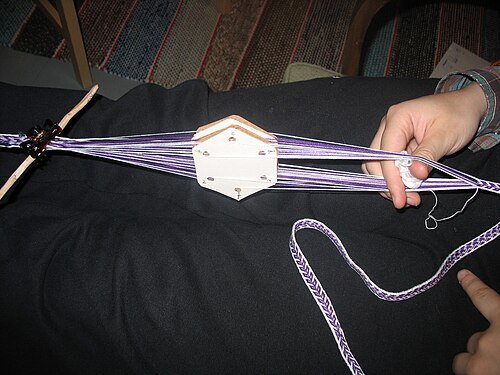
The tablets are square, usually, and small — a few centimeters across — with a hole near each corner. You thread each hole with a warp thread, stack all the cards into a deck, and attach the warp threads at both ends under tension. The pattern is determined by which direction each card is turned and in what sequence, and the weft passes through the shed that the card rotations create.
That's the whole mechanical description, and it's inadequate for conveying how strange and satisfying the technique actually is. Because what tablet weaving produces — from this arrangement of small cards, variable rotations, and a single passing thread — is patterned bands of extraordinary complexity and intricacy, with diagonal floats, threaded-in designs, and structural variations that floor looms cannot produce. The mechanism is different enough from shaft weaving that the cloth structures available are a completely different set.
How Old It Is
The oldest confirmed tablet-woven textiles are from the Bronze Age. Examples have been found in Egypt, Scandinavia, the Near East, and Central Asia, some dated to 1000 BCE or earlier. The Viking Age produced extraordinary tablet weaving: the Oseberg ship burial in Norway (834 CE) contained tablet-woven bands that are among the most technically complex surviving textile fragments in the world, with pattern structures that took modern researchers decades to reconstruct. The tablet-woven borders on Viking Age clothing were status objects, their complexity signaling the weaver's skill and the owner's wealth.
The technique spread across Eurasia with trade routes and is documented in medieval European textile traditions, in Islamic Central Asian traditions, in pre-Columbian Americas, and in South Asian textile history. Independent invention across multiple cultures is entirely plausible — the tools required are minimal — but the cross-cultural transmission of specific pattern structures along known trade routes suggests a lot of exchange as well.
Medieval European tablet weaving was used primarily for inkle bands, trim, and the decorative tablet-woven borders on ecclesiastical vestments. The borders on medieval copes and chasubles in museum collections are frequently tablet-woven, using silk and gold-wrapped thread in patterns that required hundreds of cards and weeks of work.
Modernhaus follows the thread from raw fiber to finished fabric.
Explore the Textile Studio →What the Cards Actually Do
The key to understanding tablet weaving is understanding what the card rotations create. Each card holds four threads: the four corner holes each carry one warp thread. When you rotate a card, the threads it holds twist around each other, and the two threads on top form the upper layer of the shed while the two threads on the bottom form the lower layer.
When you rotate all the cards in the same direction continuously — forward quarter-turn by quarter-turn — the warp threads accumulate twist, which creates a dense, firm band with a diagonal texture. When you change direction, the twist reverses and the accumulated twist in the threads releases. The direction and frequency of direction changes is one of the primary pattern variables.
The other variable is which threads are on top versus bottom at any given point, which is controlled by which way the card is oriented in the deck. Cards can be threaded S or Z (opposite diagonal orientations), and the interaction of threading direction with rotation direction creates the pattern. Different threading sequences create entirely different pattern possibilities: simple diagonal stripes, complex threaded-in designs, double-face patterns where the front and back of the band show different colors, and the extraordinary three-dimensional structures of some advanced traditions.
The Threaded-In and the Freehand
There are two main approaches to pattern creation in tablet weaving. In threaded-in patterns, the design is encoded in how the warp threads are threaded through the cards: the arrangement of colors in the threading creates the pattern when the cards are turned in specific sequences. In freehand (also called turning sequence-based) patterns, the design is created by the sequence of card turns the weaver makes during weaving, regardless of the threading.
The ikat weaving tradition involves planning color placement before the weaving happens; tablet weaving's threaded-in approach works similarly, with the pattern pre-loaded into the threading. Both require a kind of four-dimensional thinking: visualizing what the finished cloth will look like from an abstract representation of the setup.
Living Traditions
Tablet weaving has continuous living traditions in several regions. In Norway and Sweden, folk textile organizations have maintained and transmitted the technique through the twentieth century. In the Caucasus and Central Asia, tablet-woven bands are part of ongoing textile production. In Guatemala, a related technique called backstrap weaving uses cards differently but shares some technical principles.
The global revival of tablet weaving in the past thirty years runs through the same historical reenactment communities and craft revival networks as nalbinding and other pre-industrial textile techniques. Researchers reconstructing Viking Age and medieval European band structures have published their findings, modern weavers have tested and refined the reconstructions, and the technique has found an active contemporary community alongside its historical continuity.
What keeps people making tablet-woven bands is what has always kept people making them: the specific quality of the cloth, the particular satisfaction of a pattern structure that encodes itself in the threading, and the fact that this specific kind of band — dense, patterned, strong — is not available any other way.