Terra Sigillata: The Ancient Roman Slip That Makes Its Own Glaze
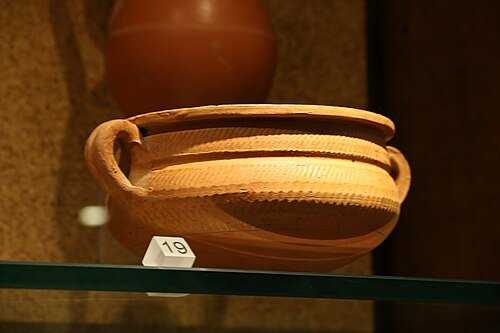
The Romans had a red tableware that was manufactured in industrial quantities and traded across the entire empire, from Britain to the Black Sea. It was called sigillata — from the Latin for "stamped" or "sealed" — and it was made by a specific process: a highly refined clay slip, decanted to remove coarse particles, applied over a leather-hard clay body, burnished to a high sheen, and then fired in a specific oxygen-controlled atmosphere that produced the characteristic red color.
The surface it created was smooth enough to be mistaken for glazed pottery. It was not glazed. There was no glass involved at all. The sheen came from the burnishing, which compressed and aligned the particles in the refined slip into a near-continuous surface, and from the firing, which sintered the slip into something close to vitrified. When you hold a piece of Roman sigillata — if you are fortunate enough to be handling one in a museum context — you are holding a surface that is both matte and luminous at the same time, in a way that glazed pottery rarely achieves.
The Roman Manufacturing System
Arretine ware, the Italian prototype of sigillata produced in Arezzo from around 30 BCE, set the standard that the provincial workshops across the empire eventually replicated. The workshops were industrial operations employing dozens of workers, each specializing in a stage of the process: mixing and decanting the slip, throwing or pressing the forms, applying and burnishing the slip, managing the kiln atmosphere.
The molds used for decorated sigillata — the bowls and cups with figured relief decoration — were themselves a specialized product, made by skilled modelers and used repeatedly. The relief decoration on sigillata was not applied by hand to individual pieces; it was pressed into the mold surface and transferred to every bowl made from that mold. This is industrial production in the proper sense, scaled to supply a population of tens of millions across a continent.
The red color comes from iron in the clay body and slip oxidizing during firing. The process required careful kiln management to maintain oxidizing conditions throughout. The Gaulish workshops at La Graufesenque and Lezoux that overtook Italian production in the first and second centuries CE were producing millions of vessels per year. Sherd deposits from La Graufesenque include what appear to be kiln load records scratched onto pottery, listing thousands of pieces per firing.
Modernhaus follows the thread from raw fiber to finished fabric.
Explore the Textile Studio →What Studio Potters Do With It Now
Contemporary terra sigillata in studio pottery is a different thing from Roman sigillata, related by principle rather than identical in practice. The modern version is made by mixing a commercial or studio-prepared clay body with water to a low-density slip, then allowing it to settle for a day or more so that the coarser particles sink. The top third or so of the settled liquid, containing the finest clay particles, is decanted off. This is the terra sigillata slip.
Applied to bone-dry or leather-hard pots, the slip produces a matte surface. When burnished with a soft cloth or the back of a spoon while still slightly damp, the fine particles compress and align, creating the characteristic sheen. Fired at low temperatures — typically cone 06 or lower — the surface retains the burnished quality while the clay vitrifies enough to produce some durability.
The color depends on the clay. Red earthenware produces the classic terracotta-red. White earthenware gives cream to buff. Adding stains or oxides to the slip produces other colors. The surface can be further modified before firing: smoke firing produces dramatic black and gray areas where carbon penetrates through cracks in the burnished surface; saggar firing with combustibles creates similar atmospheric effects.
Why It Interests Contemporary Ceramicists
Terra sigillata sits at a specific intersection that interests studio potters working with historical techniques, low-fire aesthetics, or the specific visual quality of a surface that is not quite glaze and not quite raw clay.
The sheen it produces is softer and more intimate than a high-fire glaze. It looks like the clay itself has been transformed rather than coated. On sculptural work or on vessels where the form is the focus, this can be exactly right: the surface amplifies rather than decorates.
It also behaves differently in raku firing and saggar firing than glaze does. The burnished surface cracks and takes carbon differently, producing patterns that are more subtle than the dramatic metallic effects of commercial raku glazes. Potters who work with atmospheric firing often use terra sigillata because it allows the atmosphere to mark the surface without the visual noise of conventional glaze.
The Romans solved the problem of making beautiful, functional tableware at enormous scale by developing a process that was both industrially repeatable and aesthetically sophisticated. What contemporary potters find in that process is something they couldn't get elsewhere: a surface where the material and the hand and the fire are all equally visible.