Charlotte Perriand: She Designed the LC4, Le Corbusier Got the Credit
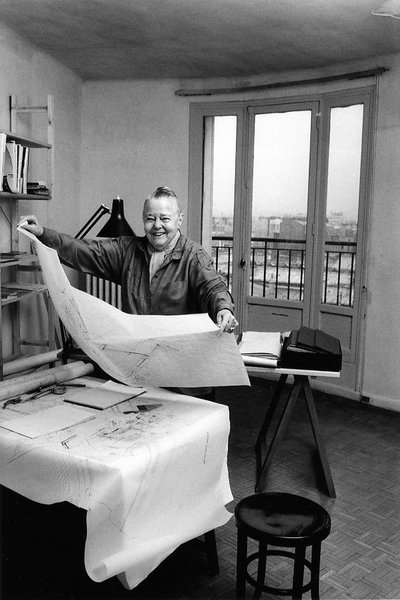
In 1927, Charlotte Perriand walked into the studio of Le Corbusier and Pierre Jeanneret on the Rue de Sèvres in Paris, carrying her portfolio. She was twenty-four years old. Le Corbusier looked at the work and said, without particular cruelty, just as a fact: "We don't embroider cushions here."
She left.
Three months later, she installed "Bar sous le Toit" (Bar under the Roof) at the Salon d'Automne in Paris. The bar was made of chrome, aluminum, and glass. There was no fabric. No cushions of any kind. It looked like the future. Le Corbusier walked through the exhibition, stopped at the bar, and sent her a note: "Come work with us."
She worked with the studio for ten years. During that time she designed the LC2 armchair, the LC4 chaise longue, the LC7 swivel chair, and much of the furniture system that became synonymous with modernist living rooms everywhere. The pieces were patented and sold as "Le Corbusier, Jeanneret, Perriand." Over the following decades, in catalog after catalog, exhibition after exhibition, the Perriand was quietly dropped.
The Bar That Changed Her Career
The LC4 chaise longue is one of the most reproduced pieces of furniture in history. You know the shape: a curved steel frame holding a long padded body, the whole thing adjustable to any angle, designed to align the spine the way a doctor would position a convalescing patient. It looks like a recliner that has been to architecture school.
The design emerged from Perriand's research into human posture and the physiology of rest, work she had been doing independently before she joined Le Corbusier's studio. The tubular steel frame was the material of the moment: the Bauhaus was using it, Marcel Breuer was using it, and Perriand had already been experimenting with it in her own apartment in Montmartre, which she had fitted out with chrome fixtures and ball-bearing shelving.
What she brought to the Corbusier studio, in other words, was not skill in implementing his ideas. It was a fully formed design intelligence that happened to align with modernism's direction.
Modernhaus documents mid-century modern design history in one place.
Explore the Design Archive →Japan and the Years Between
In 1940, the Japanese Ministry of Trade invited Perriand to Japan as an industrial design consultant. The appointment was remarkable, a French woman in wartime Japan advising on the design of export goods. She stayed for two years, traveled through rural Japan, and found in Japanese craft traditions, the precise joinery, the respect for natural materials, the philosophy of emptiness and proportion, something that confirmed and deepened what she already believed about design.
The influence went both ways. She brought Japanese craft thinking back to France and spent the postwar years integrating it into work that looked increasingly unlike the chrome militancy of the Rue de Sèvres. The furniture she designed for French mountain resorts in the 1950s and 1960s, particularly for the ski complex at Les Arcs, used wood and stone and woven materials, designed for the specific cold and compact requirements of alpine living. It has a warmth that the LC4 doesn't.
Les Arcs and the Second Career
The Les Arcs project ran from the mid-1960s into the 1980s. Perriand designed not just the furniture but the entire spatial logic of the resort's apartments: rooms that were small but layered, with built-in sleeping platforms and fold-down tables and storage integrated into every surface. Everything was multifunctional. Nothing was decorative unless it was also useful.
The work is less famous than the Corbusier collaborations, which is backwards. The Les Arcs apartments are original solutions to real problems. The LC4 is a beautiful object. Both are worth knowing, but the mountain work shows a designer operating at full independence, with nobody else's name on it.
The Long Life and the Late Recognition
Perriand lived to ninety-six, long enough to see a substantial reassessment of her contribution to the Corbusier furniture. Exhibitions, monographs, and historians gradually restored her name to the work. The LC4's authorship is now generally attributed to all three: Le Corbusier, Jeanneret, and Perriand. She said in interviews that she was not bitter about the years of omission, only that it had taken so long.
She published her memoir, "A Life of Creation," in 1998 when she was ninety-five. She died the following year. The bar she built from chrome at twenty-four turned out to be the best answer she ever gave to a dismissal.