Wassily Kandinsky: The Painter Who Gave Modernism Its Visual Grammar
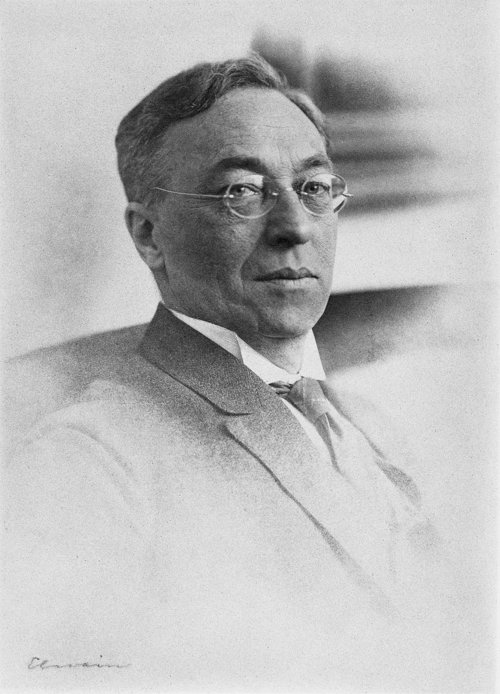
In 1896, a 30-year-old Russian law professor named Wassily Kandinsky went to an exhibition of French Impressionists in Moscow and stood in front of a Monet haystack. He couldn't identify the subject. The painting was so concerned with light and atmosphere that the actual thing it depicted, the haystack, had essentially disappeared. Kandinsky found this troubling and exhilarating in equal measure.
He enrolled in Munich's art school the same year, walking away from a professorship at the University of Dorpat that he had been specifically invited to accept. He was 30. Most serious painters start considerably younger. He didn't seem to notice or mind.
The haystack set something off in him that took twenty-six years to fully work out. The result was a theory of visual language that influenced the design of the twentieth century more thoroughly than most designers knew or acknowledged.
The Blue Rider and the Sound of Colours
Munich, 1900s. Kandinsky's early paintings look nothing like what he became. They are Russian folk tales rendered in jewel colours, decorative and warm, technically assured but not yet different from what other artists were doing. He was good. He wasn't yet himself.
The shift came gradually and then completely, the way he described seeing the haystack. By 1910 he had painted what most art historians consider the first fully abstract work in Western art: a watercolour with no identifiable subject, just colour and gesture and form. He co-founded Die Brücke der Blauen Reiter, the Blue Rider, with Franz Marc in 1911. He published Concerning the Spiritual in Art the same year.
The book argued that colour and form had direct psychological and spiritual effects on the viewer independent of any subject matter. Yellow was aggressive, warm, advancing. Blue was calm, deep, receding. Red was self-confident and vital. Green was passive and restful. These weren't metaphors. He meant them as structural properties of colour, the way a physicist means properties of matter.
He was also writing about sound. He had synaesthesia: he experienced colour as sound and sound as colour. Yellow, to him, sounded like a trumpet. Blue sounded like a cello deepening toward double bass. Green was the middle register of a violin. This wasn't poetry. It was what he actually experienced. And it gave his colour theory an unusual rigidity, because for him the relationships he was describing were perceptual facts, not aesthetic preferences.
Modernhaus documents mid-century modern design history in one place.
Explore the Design Archive →Arriving at the Bauhaus
In 1922, Walter Gropius invited Kandinsky to join the Bauhaus in Weimar. He was 55. He had already painted the first abstract works, already written the books, already survived the Russian Revolution (he and his wife Nina had fled Munich in 1914, lived through the war years in Moscow, tried to establish modernist art education in Soviet Russia and found the political situation incompatible with his ideas). By the time he arrived in Weimar he was one of the most important painters alive.
At the Bauhaus he ran the mural painting workshop and taught the fundamental design course. His students learned to see colour and form as the Bauhaus curriculum required: systematically, structurally, as design elements with measurable properties. A yellow circle advancing toward you. A blue triangle receding. A red square holding its ground.
In 1926, he published Point and Line to Plane, the second major theoretical text. Where Concerning the Spiritual had focused on colour, Point and Line broke down the basic elements of visual composition: how a point creates tension by its position on a surface. How a line moves differently depending on whether it's straight or diagonal or curved. How geometric forms contain specific emotional qualities. The horizontal as silence. The vertical as aspiration. The diagonal as dynamic potential.
These were not abstract propositions. They were taught as design principles at the most influential design school in the world, absorbed by students who would go on to shape modernism in architecture, graphic design, industrial design, and furniture. Anni Albers was in the building, translating Bauhaus principles into textile structure. Marcel Breuer built the tubular steel chair he named after Kandinsky to honour their friendship, and the name stuck. The visual language of mid-century modernism, the preference for primary colours and geometric form, the faith that good design could be derived from first principles rather than tradition, runs directly through what Kandinsky was teaching.
The Chair With His Name
In 1925, Marcel Breuer, who ran the Bauhaus furniture workshop, built a chair from chrome-plated tubular steel and canvas. He called it the Wassily Chair in honour of Kandinsky, who had admired the design and encouraged Breuer to develop it. The chair is now one of the most recognised objects of the twentieth century. It sits in the permanent collections of MoMA and the V&A. Knoll has been manufacturing it since 1968.
Kandinsky himself is more commonly remembered for his paintings than for his teaching. But the design world works with his ideas constantly: the systematic use of colour to guide attention, the geometric reduction of form to its essential properties, the belief that visual communication has structural rules that can be understood and applied. Every time a designer reaches for a primary colour accent or resolves a composition into simple geometric elements, they are working in a tradition Kandinsky did as much as anyone to establish.
The Final Decade
When the Nazis came to power in 1933, the Bauhaus closed. Kandinsky and Nina moved to Neuilly-sur-Seine, just outside Paris, where they lived until his death in 1944. He was 77. He continued painting through the Paris years, the work becoming increasingly biomorphic, organic shapes replacing the pure geometry of the Bauhaus period, as if the theory had loosened its grip and something more fluid could come through.
His estate became one of the most valuable in twentieth-century art. A 2017 auction at Christie's sold a 1909 painting for $42.5 million. Works from the Bauhaus period, where the theory and the practice are most visibly fused, command premiums among collectors who understand what they're looking at.
The books remain in print. Point and Line to Plane is still on design school reading lists. Concerning the Spiritual in Art has been through dozens of editions in dozens of languages. The haystack he couldn't identify in 1896 turned out to be the most productive object he ever looked at.
What the Bauhaus Was Actually Teaching
The Bauhaus ran for fourteen years across three cities: Weimar (1919-1925), Dessau (1925-1932), Berlin (1932-1933). In those fourteen years it produced a faculty that included Kandinsky, Paul Klee, László Moholy-Nagy, Herbert Bayer, Marcel Breuer, and Mies van der Rohe. The student body included Anni Albers, Herbert Bayer, and Marianne Brandt.
The core proposition was that art and craft and industry could be unified: that the same principles underpinning fine art also underpinned the design of a lamp or a chair or a building. Kandinsky's theoretical work was the philosophical backbone of that proposition. If colour and form have structural properties that can be systematically understood, then a painter and an industrial designer are doing the same thing at different scales.
The chair Breuer named after him holds about as much of Kandinsky's influence as his paintings do, if you know what to look for. The primary materials, the geometric reduction, the insistence that the structure is the aesthetic rather than decoration applied to structure. You sit in it and you're sitting inside a set of ideas that began with a man who couldn't identify a haystack.