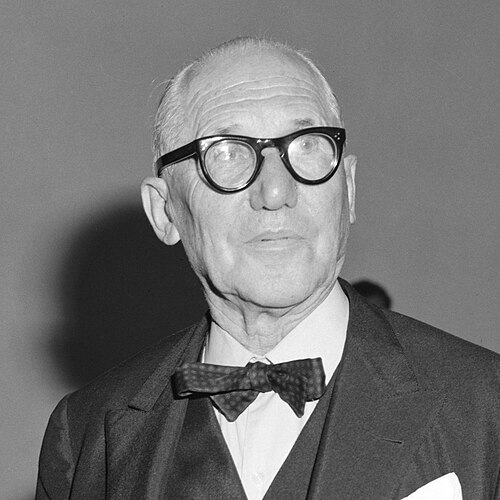
Le Corbusier: The Man Who Called Houses Machines
In October 1927, a 24-year-old designer named Charlotte Perriand visited Le Corbusier's studio in Paris. She had just graduated from the École de l'Union Centrale des Arts Décoratifs. She wanted to work there. Le Corbusier looked at her portfolio and said: "We don't embroider cushions here."
She left. A month later, Le Corbusier visited the Salon d'Automne and found himself standing in front of Perriand's installation, a rooftop bar built entirely from industrial materials: chrome, aluminum, glass. No embroidery anywhere. He offered her a job the same week.
Over the next ten years, she designed the furniture that the world still calls "Le Corbusier."
The Swiss Who Became Something Else
He was born Charles-Édouard Jeanneret in 1887 in La Chaux-de-Fonds, Switzerland, a watchmaking town in the Jura mountains where precision and function had been the local religion for centuries. He was not born Le Corbusier. He invented that name later, adapted from his maternal grandfather's surname, as part of the deliberate construction of a persona that would be easier to remember than a hyphenated Swiss name. It worked.
He was largely self-taught. His formal education was in watch engraving at the local art school, but he persuaded his teacher to let him study architecture instead, and spent his twenties traveling: Vienna, Paris, Athens, Istanbul, the Parthenon. He drew everything. He wrote down everything. He arrived at his ideas about what modern buildings should be through a process of intense looking followed by intense argument with himself on paper.
By the time he settled permanently in Paris in 1917, he had developed a position: the modern world required modern buildings. Not buildings that looked like Greek temples or medieval cathedrals. Buildings that looked like what they were: structures of reinforced concrete and steel, organized around the needs of the people who lived in them. "The house," he declared, "is a machine for living in."
Modernhaus documents mid-century modern design history in one place.
Explore the Design Archive →What a Machine for Living Looks Like
The purist villas of the 1920s are where the theory became real. Villa Savoye, completed in 1931 outside Paris, is the clearest statement: a white box raised on pilotis (slim concrete columns), with the ground level left open, a ramp spiraling through the interior rather than stairs, a rooftop terrace instead of a pitched roof, horizontal windows running the full width of each facade. His five points of architecture, made physical.
You can visit it now. It's a UNESCO World Heritage Site, green lawns, white walls, exactly as he left it. Walking through it is slightly strange, the way visiting any building whose photograph you know better than the building itself is strange. It is smaller than you think. The proportions are everything.
The Unité d'Habitation in Marseille (1952) is the other pole: not a single villa but a city block made vertical. Eighteen stories. 337 apartments. Internal streets on every third floor. Shops, a hotel, a gym, a running track on the roof. The idea was that everything you needed for daily life could exist within one building, that the city didn't need to sprawl across the land if it learned to stack instead.
Chandigarh, the planned city he designed for India in the 1950s as the new capital of Punjab, is the largest statement. He designed the Capitol Complex: the Secretariat, the High Court, the Assembly. Buildings in rough concrete, brutalist before brutalism had a name, shaped by the Indian climate and light in ways his European work couldn't have been.
The Furniture Credit Question
The LC collection, the chairs and chaises that appear in architecture magazines and design stores and Cassina showrooms worldwide, carries Le Corbusier's name. The LC2 armchair, the Grand Confort, the deep-cushioned steel-framed chair with its tubular structure visible on the outside. The LC4, the chaise longue, a curved shell of steel and leather that tilts on a straight base and can be repositioned to almost horizontal.
Charlotte Perriand designed them. Along with Pierre Jeanneret, Le Corbusier's cousin and long-term collaborator, and with Le Corbusier's philosophical framework about the chair as "a machine for sitting." But the hand that actually solved the problems of how to make tubular steel comfortable, how to engineer the chaise to tilt and lock at different angles, was Perriand's.
The collection was presented at the 1929 Salon d'Automne under the name "Equipment for the Home" and credited to Le Corbusier, Jeanneret, and Perriand. Over the following decades, as the furniture became canonical, Perriand's name dropped away from the consumer-facing credit. It was the George Nelson and Irving Harper situation, decades earlier and with a more complicated collaborative structure.
Perriand's own post-Le Corbusier career, which included remarkable work in Japan in the 1940s and an entire body of design that drew on Japanese and traditional craft materials, has been substantially reassessed since her death in 1999. The Fondation Louis Vuitton gave her a retrospective in 2019. The furniture credit question is now widely understood, even if the Cassina tags still read "Le Corbusier."
What He Nearly Did to Paris
In 1925, Le Corbusier published the Plan Voisin: a proposal to demolish most of central Paris north of the Seine and replace it with a grid of cruciform skyscrapers surrounded by parkland, highways, and a new geometric street plan. He was serious. He presented it at the Exposition Internationale des Arts Décoratifs. He thought it was the solution.
The plan was never built. Paris is still Paris. But the Plan Voisin is useful as a window into Le Corbusier's particular kind of confidence: the absolute certainty that the correct solution to the problem could be derived from first principles, and that sentiment, history, and the accumulated messiness of an actual city were obstacles rather than resources.
That confidence produced extraordinary buildings. It also produced ideas that, if implemented, would have been catastrophic.
The Man in the Water
On August 27, 1965, Le Corbusier went for his morning swim in the Mediterranean at Cap Martin, where he had a small cabin he'd built himself, the smallest thing he ever designed: three meters by three meters, with a narrow bed and a fold-down table. He was 77. His wife Yvonne had died the previous year.
He didn't come back from the swim. He was found floating in the sea. Heart failure, the doctors concluded.
He was buried, at his own request, near Cap Martin. The cabin still stands.
The Numbers
Cassina has held the exclusive license to manufacture the LC furniture collection since 1965, including the right to enforce Le Corbusier's copyrights internationally. The copyrights expired in most of Europe in 2015 (70 years after his death). In the United States they remain contested.
An authentic Cassina LC4 chaise longue retails at around $8,500. An LC2 armchair runs to around $4,200. The replica market is enormous: reproduction chaises appear from $400 upward, with varying fidelity to the original engineering. The distinguishing details are in the chrome quality, the leather stitching, and the tilt mechanism of the chaise, which on the original is genuinely smooth and on most replicas is not.
Le Corbusier's buildings are UNESCO World Heritage Sites on three continents. His books, particularly Towards a New Architecture (1923), remain in print and on architecture syllabuses. The chair named after Kandinsky at the Bauhaus has Perriand's engineering inside it.
He would probably be fine with all of that. The work was always the point.