Backstrap Loom: The Body as Part of the Machine
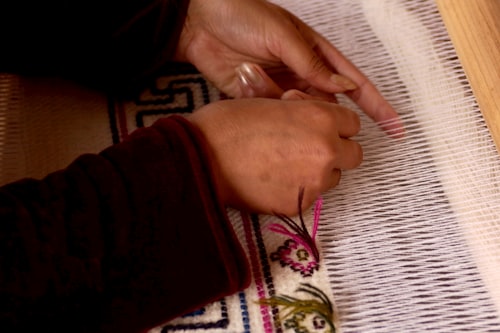
The backstrap loom has been in continuous use for at least four thousand years. It operates across Mesoamerica, the Andes, Southeast Asia, Japan, and parts of Africa. It has no moving parts and weighs almost nothing. It produces some of the most technically demanding textiles ever made. The entire mechanism fits in a bag.
The setup: one end of the warp lashes to something fixed — a tree, a post, a hook in a wall. The other end connects to a strap or a rigid bar that passes across the weaver's lower back or hips. Tension is maintained by leaning back against the strap. When the weaver leans forward, the warp loosens and threads can be manipulated. When they lean back, the warp tightens and the shed opens cleanly. The weaver's body is not separate from the loom — it is part of the mechanism.
What the Body Does
This sounds precarious. In practice it gives the weaver something no floor loom provides: instantaneous, continuous, infinitely variable control over warp tension through body movement. A skilled backstrap weaver can feel the warp through the strap the way a woodworker feels vibration through a chisel handle. Tight threads can be eased. Loose threads can be drawn taut. The feedback is direct and physical in a way that the mechanical tension systems on shaft looms are not.
The portability follows from this. The entire loom — heddle bars, shed sticks, shuttle, the warp itself — rolls into a compact package. Backstrap weavers have historically worked wherever conditions allowed: in doorways, under trees, in markets. The loom is not furniture. It is equipment.
Modernhaus follows the thread from raw fiber to finished fabric.
Explore the Textile Studio →Guatemala and the Maya Tradition
In the highlands of Guatemala, the backstrap loom has been in continuous use since the pre-Columbian period. Mayan backstrap textiles — huipiles, tzutes, faja belts — use supplementary weft techniques to produce brocaded patterns of extraordinary density. A single huipil blouse from a specific village contains pattern vocabulary that identifies the weaver's community, her lineage, and often her status within it. Each village maintains its own distinct pattern traditions, encoded in the cloth.
The Spanish colonial administration tried to standardize and tax textile production in the sixteenth century. The Maya weavers encoded resistance into the patterns, hiding community identifiers in structures the colonizers couldn't read. The cloth was documentation that couldn't be confiscated.
The Andes
Andean backstrap weaving produced different structures but comparable complexity. The warp-faced cloths of the Inca period — and of the Andean cultures preceding the Inca by a thousand years — achieved thread counts and structural density that modern analysis still struggles to explain fully. Double-weave cloth (two layers woven simultaneously and connected at the edges) was produced on backstrap looms without mechanical assistance. The structure requires planning a warp that is two cloths deep.
Ikat traditions in Andean weaving further complicated the process: the warp threads were resist-dyed in patterns before being set up on the loom, requiring the weaver to align pre-dyed sections of warp precisely during warping. The margin for error was zero.
Relationship to Other Looms
The backstrap loom produces the same basic weave structures as other looms — plain weave, twill weave, supplementary weft — but through different means. Where a rigid heddle loom mechanizes the shed opening with a heddle frame, and a floor loom mechanizes it further with treadles, the backstrap loom manages it manually, with shed sticks and simple heddle arrangements controlled by the weaver's hands.
The inkle loom and the backstrap loom share a logic: both are warp-dependent structures where pattern originates in the warp rather than in complex shaft sequences. Weavers trained in one often find the other intuitive.
What the backstrap loom cannot easily do is produce fabric wider than the weaver's armspan — roughly 24 to 30 inches. Wide cloth required wider equipment, which is how shaft looms with their fixed frames came to dominate industrial production. The narrowness of backstrap fabric is a physical constraint, not a design choice.
The Loom as Knowledge
There is an argument — made by textile scholars who study both archaeology and living traditions — that the backstrap loom is not primarily a production tool but a knowledge transmission system. Learning to weave on it requires learning pattern libraries that exist only in the hands and eyes of experienced weavers. The patterns don't have names in many traditions; they are passed through demonstration and practice. The loom is the archive.