Inkle Loom: The Narrow Band Loom That Fits on a Desk
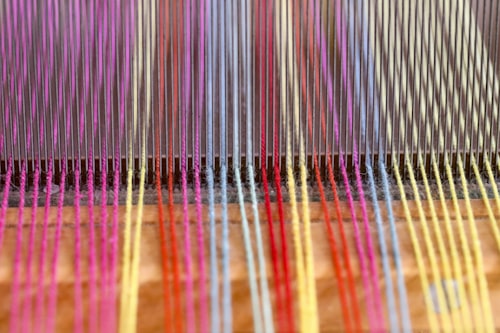
The inkle loom is a small, portable frame loom designed to weave narrow bands: belts, guitar straps, bag handles, hat bands, bookmark-width strips of cloth, decorative trim. The finished fabric is completely warp-faced — the weft thread is packed so tightly that it disappears between the warp threads and the surface you see is made entirely of warp. Pattern comes from the color arrangement of the warp.
The loom itself is a series of pegs on a frame. The warp is wound in a continuous loop around the pegs, creating two layers of threads that can be separated to form a shed. Half the warp threads pass through heddles — small loops of string — and half pass over a fixed peg. Pressing the heddles down opens one shed, releasing them opens the other. A shuttle carries the weft back and forth through these alternating sheds, and the weaver beats each weft pass firmly so the warp covers it completely.
The Word "Inkle"
The word predates the modern loom. In sixteenth-century England, "inkle" referred to linen tape or braid — cheap, utilitarian stuff sold by the yard for trimming garments and binding hems. Shakespeare mentions it. Jonson mentions it. The narrow fabric was woven on frame devices that have since been rationalized into the loom sold today under the same name.
Modernhaus follows the thread from raw fiber to finished fabric.
Explore the Textile Studio →What an Inkle Loom Produces
The structure is efficient for specific purposes and inefficient for others. Because the weave is warp-faced, you have complete control over the pattern by planning your warp color sequence before you thread. A belt with stripes, chevrons, diamonds, or lettering — all of that is determined at the warping stage, not during the weaving. The actual weaving is repetitive and meditative in a way that complex pattern work is not.
The limitation is width. Inkle looms typically produce bands between half an inch and three inches wide, though wider versions exist. Anything wider than that starts to require equipment that belongs to a different tradition — backstrap loom territory, or the shaft looms used for fabric weaving.
The connection to rigid heddle weaving is direct and practical. Many weavers begin on rigid heddle looms before moving to floor looms, and inkle weaving sits alongside that path as a way to understand warp-faced structures before encountering them in tablet weaving or backstrap loom traditions. The color logic of inkle patterning — planning the stripe sequence in advance — is the same thinking required for more complex warp-based pattern techniques.
Historical Use
Warp-faced narrow bands appear in the archaeological record across most of the world. Viking Age Scandinavia produced them in large quantities — bands for binding clothing, decorating textiles, attaching brooches. The Oseberg burial (834 CE), which also contained the earliest known tablet-woven bands in Scandinavia, included multiple narrow warp-faced pieces. Medieval European needlework and garment trims relied on similar bands. Andean textile traditions produced warp-faced bands and cloths of extraordinary complexity using backstrap looms.
The modern inkle loom is largely a twentieth-century pedagogical device — a simplified, standardized tool for introducing warp-faced weaving to people who don't have room or budget for a floor loom. It does that job well, and the bands it produces are genuinely useful objects.
Getting Started
The set-up is faster than most weaving equipment. Warping an inkle loom takes twenty minutes. The calculations are simple: decide how wide the band should be, how many warp threads that requires at your chosen sett, lay out the color sequence, wind the warp. The heddle loops are made from string and tied on during warping. There is no dressing the loom in the complex sense a floor loom requires.
For weavers who have started with twill weave structures on shaft looms, inkle feels almost austere — the structural simplicity is the point. For weavers just starting out, the quick setup and fast results make it one of the more satisfying first projects in the weaving family.