Joe Colombo: The Designer Who Ran Out of Time
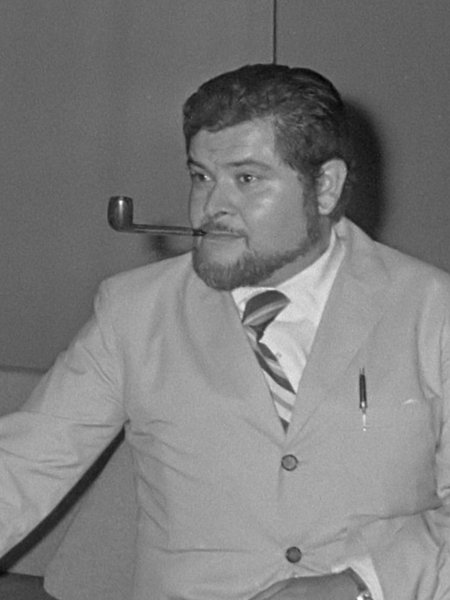
Joe Colombo died on July 30, 1971. He was forty years old. His "Total Furnishing Unit" — a complete modular living system, kitchen and bed and wardrobe compressed into four interlocking blocks — was installed at MoMA's landmark "Italy: The New Domestic Landscape" exhibition the following May. He never saw it. He never saw any of the recognition that followed, and there was a great deal of it.
He had known about the heart condition for years. Some of the people who worked with him say the urgency of those ten years, the pace of it, wasn't ambition so much as arithmetic. He had things to work out and a limited amount of time to work them out in. Whether that's biographical fact or a story we tell to make sense of compressed genius, what's certain is that almost no designer in the twentieth century moved faster, produced more, or left less unfinished.
From Nuclear Painting to Plastic Chairs
He was born Cesare Colombo in Milan in 1930. He studied fine arts at the Accademia di Brera and then architecture at the Politecnico di Milano, and as a student he joined the Nuclear Painting movement, a group of abstract artists who believed painting needed to respond to the atomic age, to physics breaking matter down to its smallest components. The work was raw and strange and had nothing to do with furniture.
The shift came in the late 1950s when his father's construction business needed someone to handle the interior design of a newly acquired boat club. Colombo took it on. Something in the process of designing a space for living, for actual use, for actual bodies in actual rooms, caught him completely. He closed his painting studio and didn't look back.
What followed was ten years of work that still looks fresh. The Universale Chair (1965, Kartell) was the first adult chair made entirely from injection-molded plastic — designed in modular sections so you could swap the legs to change the seat height, stackable, available in nine colors, cheap to produce. It was everywhere. It still is. The Tube Chair (1969) took four padded cylinders and let users lock them together in multiple configurations, which sounds gimmicky until you sit in one and realize it's genuinely comfortable in ways that conventional upholstery is not. The Boby Trolley (1970), a three-legged rotating storage cart with swinging tray compartments, is still in continuous production and still in offices all over the world.
Modernhaus documents mid-century modern design history in one place.
Explore the Design Archive →The Apartment That Was Also a Laboratory
His own apartment in Milan was a permanent experiment. Every piece of furniture was functional to an extreme degree; nothing was decorative for its own sake. His "Additional System" (1967) broke the conventional sofa into wedge-shaped modules that users could assemble into any configuration they wanted. His "Multi Chair" could fold and reconfigure into nine distinct positions. His "Combi Center" combined a television, bar, stereo, and writing surface into a single rotating unit.
The governing idea across all of it was that the home needed to be rethought for a world of increasing mobility and decreasing space. People were moving more, living smaller, owning less. The furniture of the past assumed permanence, assumed a large house with dedicated rooms for dedicated functions. Colombo thought that was finished.
The Future That Arrived Without Him
The "Total Furnishing Unit," commissioned for the 1972 MoMA show alongside work from Ettore Sottsass, Joe Colombo, and the generation that was reshaping Italian mid-century design, was the summation of everything. Four units — Night Cell, Kitchen, Cupboard, and Privacy — contained everything a person needed to live. Folded out they filled a room; folded in they barely took up a corner. It was the apartment of the future in miniature, designed by a man who had a very clear sense of what the future would ask of us.
He was in a hospital in Milan when the show opened in New York. He had been dead for ten months.
The designs kept selling. Kartell reissued the Universale Chair. B-Line kept the Boby Trolley in production. The retrospectives came, the museum collections, the assessments that called him visionary, which is true, though it misses something. What Colombo actually was, was practical. Every single thing he made was meant to be used, built for a real person with real constraints in a real shrinking world. The vision was incidental. The thinking was engineering.
Forty years is not enough time to change design. It turned out to be plenty.