Oscar Niemeyer: The Communist Who Built Brazil's Capital
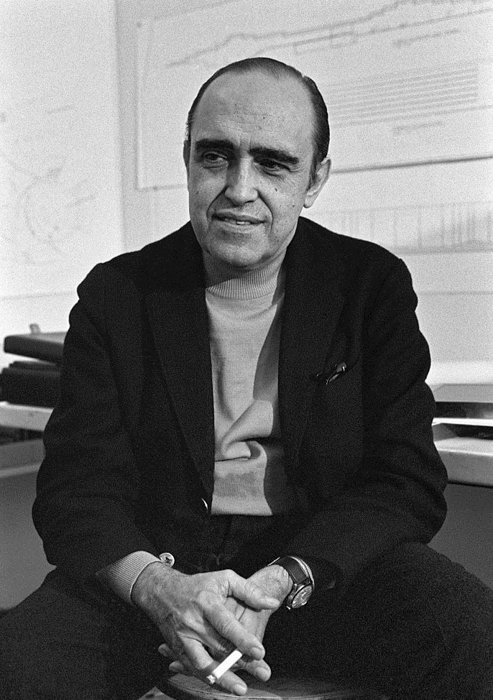
Oscar Niemeyer died on December 5, 2012, ten days before his 105th birthday. He had spent the previous week in a Rio de Janeiro hospital with a respiratory infection, still working, still talking about architecture, still making the case for curves.
He had been born in 1907. In the century and four years between, he designed around 600 buildings, joined the Communist Party of Brazil in 1945 and remained a member for the rest of his life, built the capital of a country from scratch, lived through a military coup that forced him into exile for twenty years, returned, won the Pritzker Prize at 81, and wrote an autobiography he titled The Curve of Time.
He left a very clean legacy: everything he built is still standing, and none of it looks like anything else.
Rio and the Young Man Who Studied with Lucio Costa
Oscar Ribeiro de Almeida Niemeyer Soares Filho was born in Rio de Janeiro in 1907, into a middle-class family of German and Portuguese descent. He studied architecture at the National School of Fine Arts in Rio, and shortly before graduating in 1934, entered the office of Lúcio Costa, the leader of the Modernist movement in Brazilian architecture.
Costa was introducing Le Corbusier's ideas to Brazil: the pilotis, the roof garden, the free plan. Niemeyer absorbed all of it and almost immediately started doing something different with it. Where Le Corbusier's buildings were geometric and angular, defined by right angles and Purist forms, Niemeyer's began to curve. He was thinking about the landscape he had grown up in: the hills of Rio, the beaches, the mountains dissolving into the sea. Straight lines felt imported. Curves felt native.
In 1936, Le Corbusier came to Rio as a consultant on the design of the new Ministry of Education and Health building. Niemeyer worked on the project. He and Le Corbusier talked. The Swiss master was interested in what the young Brazilian was doing with his forms. Niemeyer was 29. Le Corbusier was 49 and already canonical. The Brazilian took what was useful from the conversation and kept moving in his own direction.
Modernhaus documents mid-century modern design history in one place.
Explore the Design Archive →The Communist Architect
In 1945, Niemeyer joined the Brazilian Communist Party. He was 37. The party was legal at the time; Brazil's Communist Party had been founded in 1922 and operated in various states of legality throughout the decades that followed. Niemeyer's politics were consistent with his design philosophy: he wanted to build for ordinary people, not for the wealthy.
This created a tension that ran through his entire career. His most famous buildings were government buildings, civic monuments, the architecture of the state. He was building the palace of power for governments he didn't entirely trust, in a country where the distribution of that power was deeply unequal. He never resolved this tension cleanly. He kept building, kept arguing, and kept his party membership.
In 1964, the military took power in Brazil. Niemeyer's name was on the surveillance lists. He left the country and opened an office in Paris, where he would stay for twenty years. He designed the Communist Party of France headquarters in Paris during this period, a project that gave him considerable satisfaction.
Building a Capital
The story of Brasília is the story of a government that decided to move the capital of Brazil from the coast into the interior of the country, to force development, to make a statement about the future. President Juscelino Kubitschek announced the plan in 1956 and set a deadline: the city would open in 1960.
Lucio Costa won the urban planning competition. Niemeyer was appointed chief architect. The brief was essentially: design the civic buildings for a city that doesn't yet exist on a timeline that has no margin.
What he designed in those four years became one of the most significant architectural ensembles of the twentieth century. The National Congress of Brazil: two towers rising from a flat platform, flanked by two bowls, one a dome and one inverted like a satellite dish. The Palácio da Alvorada, the presidential residence, with its distinctive curved colonnade that looks like it's moving. The Cathedral of Brasília: sixteen curved concrete columns rising from the ground and meeting at the top, the interior bathed in coloured glass light. The Supreme Court. The Palácio do Planalto.
All of it designed with reinforced concrete pushed into forms that had never been used at this scale before. Engineers worked out how to make them stand up. Niemeyer had the ideas; his engineering collaborators had to calculate whether the ideas were buildable. Mostly they were.
The city opened in April 1960. Niemeyer had delivered.
The Philosophy of Curves
He explained his preference for curves in terms that mixed poetry and conviction in a way that's difficult to paraphrase. The straight line, he said, is artificial, invented by humans, belonging to the machine. The curve is natural: the mountains, the rivers, the waves of the sea, the body of the woman he loved. To design with straight lines only was to work against the grain of the world.
"I am not attracted to straight angles or to the straight line, hard and inflexible, created by man. I am attracted to free-flowing, sensual curves. The curves that I find in the mountains of my country, in the sinuousness of its rivers, in the waves of the ocean, and on the body of the beloved woman. Curves make up the entire Universe, the curved Universe of Einstein."
This is either a design philosophy or a manifesto or a love letter, depending on how you read it. It is, as architectural statements go, unusually honest about where the impulse comes from.
After Exile
Niemeyer returned to Brazil in 1985 when democracy was restored. He was 77. He received the Pritzker Prize in 1988. He continued working. The Niterói Contemporary Art Museum (1996), a flying-saucer form on a hillside overlooking Rio's bay, the Museum of Contemporary Art in Niterói. The Latin America Memorial in São Paulo. The Serpentine Gallery Pavilion in London in 2003, the first Pavilion by a non-British architect.
He was designing at 100. He was working at 104. The respiratory infection that killed him was a surprise to people who had stopped expecting him to die.
His buildings are the most visited architectural sites in Brazil. Brasília itself is a UNESCO World Heritage Site, the only city built in the twentieth century to receive the designation. The buildings Niemeyer designed there in four years, on a deadline set by a president who wanted a capital before the next election, are among the most reproduced architectural images in the world.
The curve, it turned out, was very good for photographs.
What Zero Competition Means for a Legacy
The keyword research that brought us to Oscar Niemeyer shows zero competition for his name in search. That's unusual for someone of his stature, and it suggests a gap between the significance of the work and the amount of quality writing about it in English. His buildings are famous. His story is not as widely told in English as it deserves to be.
He was a Communist who built palaces for the Brazilian state. A modernist who rejected modernism's preference for right angles. A man who worked for nearly eighty years, designed six hundred buildings, and died at 104 still making the case for curves. The straight line, he maintained until the end, was a human invention. The curve was something else: the actual shape of things, once you stopped imposing your geometry on them.